Rules and advice
What does the Ministry of Justice and Public Security do?

The Ministry of Justice and Public Security has political responsibility for the police, the framework for the courts, the Correctional Service and large parts of legal aid. Here we explain what the ministry does, how laws are made, and how you can influence the process.
Updated · By Justice for All Norway · Information about AI in our articles

Official description
The Ministry of Justice and Public Security is responsible for the justice sector, including the police, the Correctional Service, emergency preparedness and civil protection, and for legislation on the courts, criminal procedure and civil procedure. The ministry prepares legislative proposals and the budget for the Storting (the Norwegian Parliament).
Source: Government.no
Answers to what people most often wonder about the Ministry of Justice and Public Security, with the law step by step and the experiences of our members.
The Ministry of Justice and Public Security (JD) is the government ministry for the justice sector. It has overall political responsibility for the police through the National Police Directorate, for the Correctional Service and for civil protection and emergency preparedness. It prepares the laws that govern criminal cases and civil cases, and sets the financial framework for the courts through the state budget.
It is important to distinguish responsibility from control. The ministry cannot instruct a judge, and it cannot decide the outcome of a criminal case. The courts are independent, and the prosecuting authority, with the Director of Public Prosecutions at the top, makes its own decisions in individual cases. But the ministry decides much of the framework within which they work: the laws, the money and the organisation.
Most major legislative amendments begin with a committee that examines a topic and submits a Norwegian Official Report (NOU). The Courts Commission’s report NOU 2020: 11 “The third branch of government” is one example. The Baneheia Committee’s reports NOU 2024: 24 “Tried again” and NOU 2026: 3 are another.
After a NOU, the ministry sends the matter out for consultation. Then anyone, associations, professional communities and individuals, can submit their views. The government then presents a proposition to the Storting, the Standing Committee on Justice considers it, and the Storting passes the law.
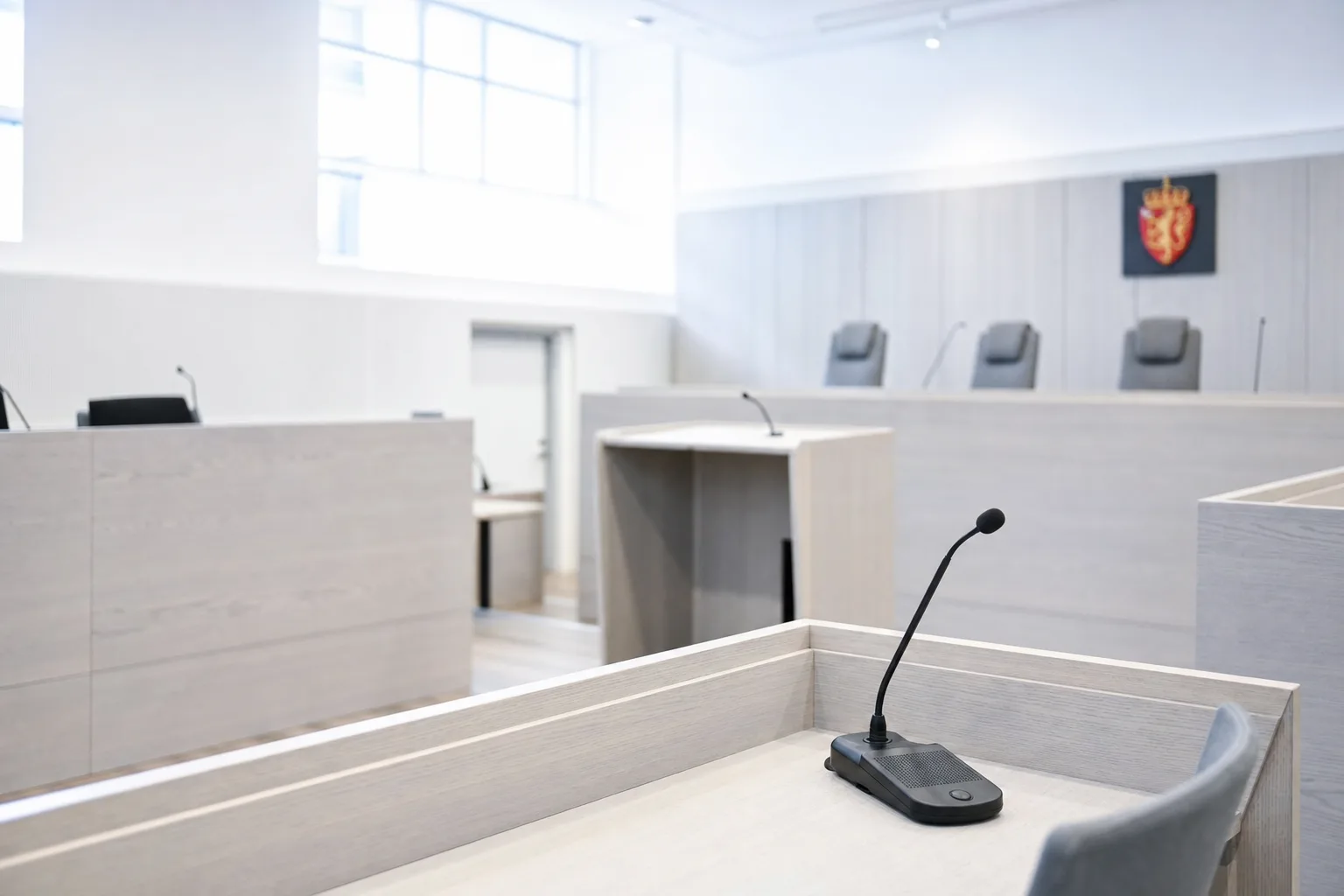
A long time can pass between a decision and reality. In 2005, the Storting decided that testimony in court should, as a general rule, be recorded. You can read what happened in the article about the 2005 decision.
Justice for All Norway works to ensure that the cases our members have experienced are made known to those who are responsible. Among other things, we have argued that the Civil Service Act (statsansatteloven) must be amended, so that public employees who commit offences in the course of their duties can be prosecuted.
We have also written about the digitalisation of the courts and what it means for ordinary people in “The case portal for you and me”: that lawyers and the prosecuting authority have digital access to the case, while a person who is a party themselves often does not.
The association’s overall work to strengthen the rule of law is gathered under the rule-of-law initiative.
Several schemes that mean a great deal to individuals fall under the ministry. Legal aid provides support for a lawyer in certain cases; the rules were amended by the new Legal Aid Act from 15 October 2025. You can find more on this under lawyers and legal aid.
The Norwegian Criminal Cases Review Commission is an independent body that assesses whether criminal cases should be heard again – see miscarriages of justice and reopening. The Norwegian Bureau for the Investigation of Police Affairs investigates cases in which police employees may have committed criminal offences in the course of their duties. The Norwegian Criminal Injuries Compensation Authority handles claims from people who have been subjected to violence.
When these schemes work, they are part of the rule of law. When they do not – for example when deadlines are short, processing takes a long time or oversight is not genuinely independent – they become part of the problem.
Consultations are open to everyone. On regjeringen.no you will find the documents and the deadline, and you can submit a consultation response yourself. A good consultation response is short, specific and based on your own experience: what happened, which rule led to it, and what should have been different.
You can also contact the Standing Committee on Justice at the Storting (the Norwegian Parliament), or the political parties. Justice for All Norway gathers members’ experiences and presents them together. The more people who document their case, the harder it is to dismiss them as isolated instances.
The courts’ budget is adopted by the Storting (the Norwegian Parliament) on the basis of a proposal from the government. The amount of money allocated determines, among other things, how quickly cases are processed, whether courtrooms receive recording equipment, and how many judges there are. The courts are administered by the Norwegian Courts Administration, which is independent of the ministry in its day-to-day operations.
When case handling times increase, it affects those who are waiting. A long wait in a child welfare case, a criminal case or a compensation case is not just an inconvenience – it can in itself be a due process problem. The European Convention on Human Rights (ECHR) gives the right to a hearing within a reasonable time.
Justice for All Norway has three main demands of the ministry. The first is recording all testimony in court, as the Storting (the Norwegian Parliament) decided in 2005, with enough equipment in all courtrooms. The second is genuinely independent oversight of the police and prosecuting authority, where the person who complains is told what has actually been investigated. The third is that individuals are given digital access to their own case on the same footing as lawyers.
We follow up the demands in consultations, in meetings and by documenting members’ cases. When a new NOU or a new legislative proposal is published, we write about it here.
Much of what happens in the justice sector is based on reports and inquiries. When a committee submits an NOU, the ministry receives a knowledge base – but also a responsibility to follow up. The Baneheia Committee’s two inquiries, NOU 2024: 24 “Tried again” and NOU 2026: 3 on the criminal prosecution of Viggo Kristiansen, are examples of reports that point to weaknesses throughout the criminal case process.
Justice for All Norway believes that the follow-up of such reports must be open. It should be possible for everyone to see which recommendations have been followed up, which have not, and why. Only in this way can the Storting (the Norwegian Parliament) and the public hold the ministry accountable.
Several of the oversight bodies in the justice sector are administratively attached to the ministry, but professionally independent. This applies, among others, to the Norwegian Criminal Cases Review Commission and the Norwegian Bureau for the Investigation of Police Affairs. Independence is crucial to trust: the person who complains must be able to trust that the assessment is not influenced by consideration for the agency that has been criticised.
Justice for All Norway believes that independence must be shown in practice, through open procedures, reasoned decisions and the possibility of access to what has been investigated.
The Minister of Justice and Public Security, who is a member of the government and is politically accountable to the Storting (the Norwegian Parliament).
No. A judgment can only be appealed to a higher court, or a reopening can be requested from the Norwegian Criminal Cases Review Commission.
A Norwegian Official Report: a report from a committee appointed by the government, often forming the basis for new legislation.
Find the consultation on regjeringen.no and follow the link for submission. Anyone can respond, including private individuals.
6 articles, newest first.
Rules and advice
News
News

News
Recordings in court
Leif Morten Larsen