News · Recordings in court
Parliament passed it in 2005. Twenty-one years later, we are still waiting
When the Dispute Act was passed in 2005, the main rule became that testimony in court shall be recorded. The cost was estimated at around NOK 9 million. Today only a few courts have the equipment.
In brief
- The Dispute Act was passed in June 2005. The main rule became that testimony from parties and witnesses shall be recorded.
- The Standing Committee on Justice estimated that audio recording in all courtrooms would cost around NOK 9.1 million, in addition to an archive.
- Since 2018 both the Dispute Act and the Criminal Procedure Act have said “shall”, but with an exception when the court lacks equipment.
- In the autumn of 2026, only a few courts had equipment, through a pilot project.
- Justice for All Norway believes that the lack of recordings is a major reason for judgments that do not reflect what happened in court.
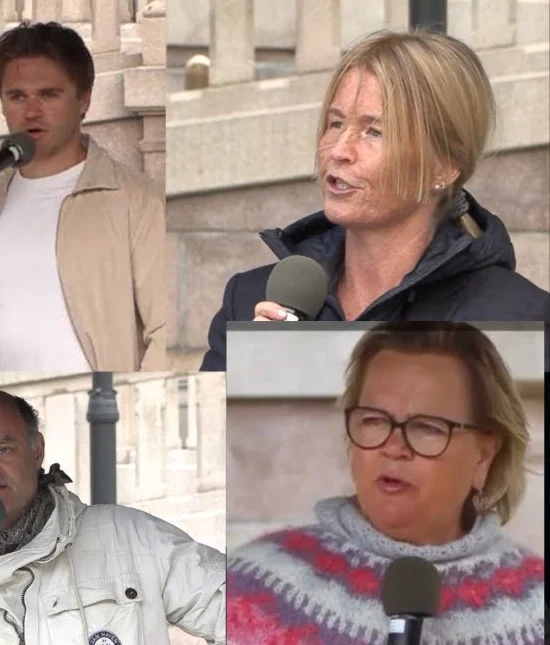
On 23 May 2025 people stood outside the Storting demonstrating for the rule of law. Justice for All Norway filmed the demonstration. One of the demands the association has made from the very start is simple: what is said in court must be recorded.
The interview is in Norwegian. English subtitles are coming.
The decision
The Odelsting passed the new Dispute Act on 6 June 2005, and the Act was dated 17 June 2005. The ministry proposed a main rule that all testimony from parties and witnesses shall be recorded, by audio or video. The recommendation from the Standing Committee on Justice sets out the costs: a central archive was to cost NOK 7.5 million, and audio recording in all courtrooms a further NOK 9.1 million. Operation was to cost NOK 300,000 a year. The ministry intended to introduce the scheme “in due course” and spread the costs over several years.
The court may refrain from recording when “the court does not have the necessary recording equipment available”.
How it is today
Where there is no equipment, it is the judge who takes notes. The testimony is not written down verbatim, and there is no stenographer. When a case is appealed, the witnesses must as a rule give evidence again. What they said the first time exists only in the notes and in the judgment.
Other countries
Many countries record court proceedings. In Sweden, testimony in the district court has been video-recorded since the 2008 reform “En modernare rättegång” (A more modern trial), so that the court of appeal can play it back. The Méndez Principles, the international principles on interviewing that Norwegian professionals helped to draw up, regard recording of the entire interview as a fundamental safeguard.
The world’s second-best rule of law
Norway came second out of 143 countries in the World Justice Project’s Rule of Law Index for 2025. Among other things, the index asks whether court proceedings are open and verifiable.
Sources
- Justice for All Norway: Demonstration for the rule of law, the Storting, 23 May 2025
- Recommendation O. no. 110 (2004–2005) on the Dispute Act (costs and main rule on recording, in Norwegian)
- Odelsting Decision no. 99 (2004–2005), the Odelsting’s decision of 6 June 2005 (in Norwegian)
- Minutes of the Odelsting, 6 June 2005 (in Norwegian)
- The Dispute Act (tvisteloven) section 13-7 (Lovdata, amended by Act of 22 June 2018 no. 79)
- The Criminal Procedure Act (straffeprosessloven) section 23 (Lovdata)
- Recommendation 128 L (2025–2026) to the Storting, cf. Bill 163 L (2024–2025) (in Norwegian)
- Rett24, 18 September 2026: Lawyers react to the courts wanting to record the breaks (in Norwegian)
- Rett24, 28 January 2026: The Judges’ Association fears new rule on audio recordings will create a two-track system (in Norwegian)
- The Méndez Principles (PDF)
- WJP Rule of Law Index 2025
Quotes translated from Norwegian.
Published 27 May 2025 at 15:30
About AI in our articlesSupporting members
Support Justice for All Norway from abroad
Membership of the association is open to people living in Norway. International supporting memberships are on their way, so that you can support our work wherever you live.
Become a supporting memberComing soonSupport our work
Related articles
Three in four are refused when they apply for patient injury compensation

Limit values assess one substance at a time. The body meets many

Amicable settlement with VG: – We should simply have called you

We published the entire closing speech. The court makes no such recording itself
Children who speak out have the right to be taken seriously