Audio recordings in Norwegian courts?
When the Danish company Dictus was developing and fine-tuning its speech recognition tool for Denmark’s first impeachment trial against a politician in almost 30 years – the case against Inger Støjberg – it needed a training ground. The choice fell on the Storting.
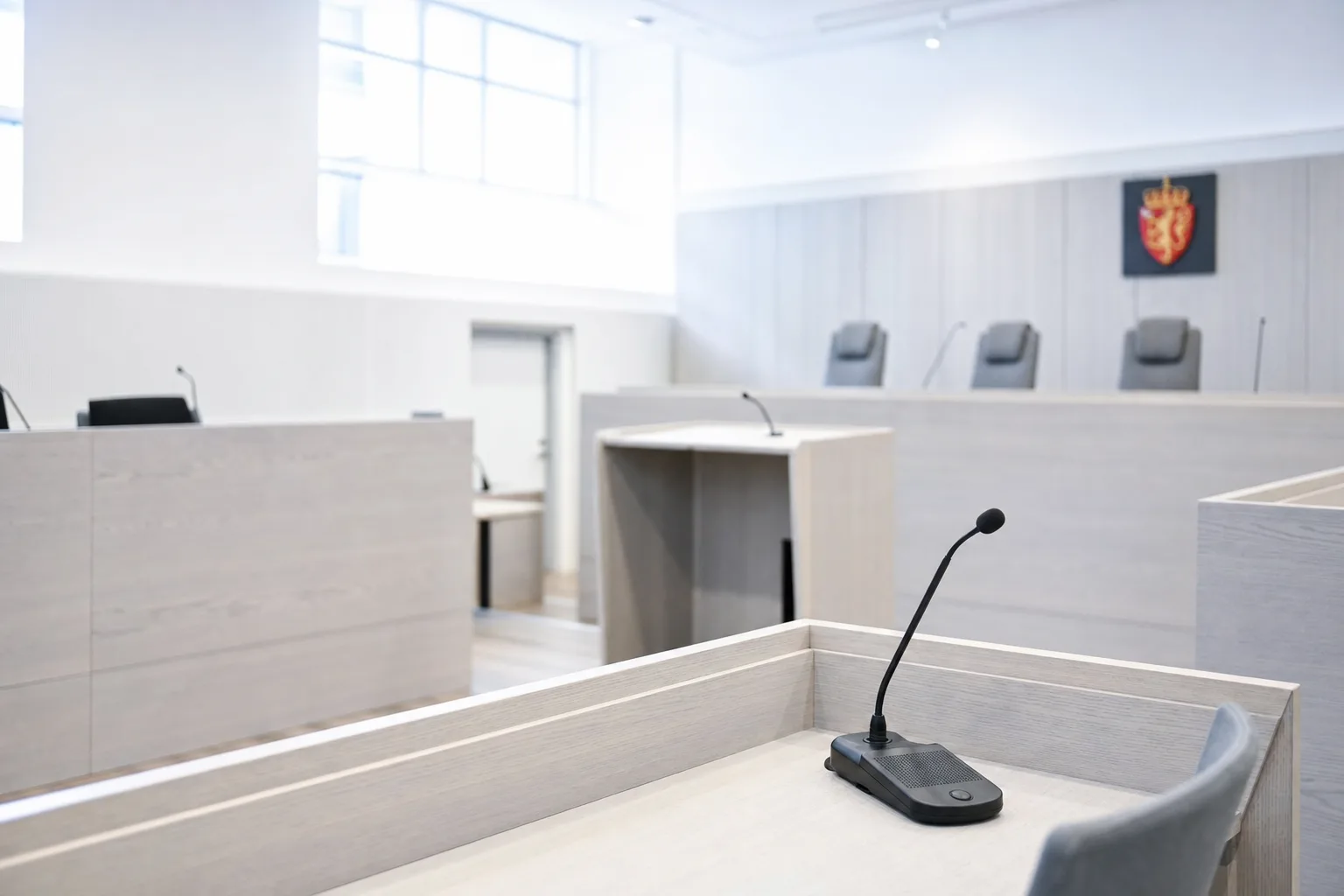
The technology recognises the voices and dialects of a wide range of different people, so that the system automatically registers who is speaking and what they are saying, with precise transcription. The system has been in use in the Storting (the Norwegian Parliament) for several years. Every day a direct transcription is produced of what has taken place in the chamber and who said what, before the text is finally quality-assured by people. Better documentation is not possible.
Dictus supplies the same system to Danish courtrooms, and has done so for many years. When we spoke to them, they were very surprised to hear that Norwegian courts still do not have audio recording as a standard arrangement – nor any system that ensures that everything said in a courtroom can be checked and traced back with precision.
We also contacted Domstolsverket, the Swedish National Courts Administration, to hear what kind of system they use. They were just as surprised that Norway does not document its court cases in audio. In Sweden this has been the practice for many years, with well-established systems for recording in the courts.
What has been going on in Norway, given that the Norwegian Courts Administration (Domstoladministrasjonen) and Norwegian judges have for more than 20 years failed to follow up the legislature’s – the Storting’s – decision on audio recording in the courts?
Justice for All Norway’s review team is now working on our members’ cases. These are around 500 cases in which people have been subjected to very serious breaches of the rules – in the public administration in connection with decisions, and in the courts in connection with outcomes that are out of proportion to the documentation and the substance of the case.
It is therefore very surprising that Norway, which according to the World Justice Project ranks second in the world for the rule of law, is the only country in Scandinavia that has not introduced audio recording as a standard arrangement – that is, an opportunity for full transparency and review of what emerges during the main hearing in the district court and in the appeal proceedings.
Read more about this technology at Dictus here
Sources:
- Written question 15:560 (2023–2024), answer from the Minister of Justice (in Norwegian)
- Supplementary letter of allocation No. 2 to the Norwegian Courts Administration, 2024 (in Norwegian)
- Bill Prop. 163 L (2024–2025) (in Norwegian)
- Private member’s motion 123 S (2011–2012) (in Norwegian)
- The Storting, vote of 29 November 2012 (in Norwegian)
Published 11 October 2026
About AI in our articlesSupporting members
Support Justice for All Norway from abroad
Membership of the association is open to people living in Norway. International supporting memberships are on their way, so that you can support our work wherever you live.
Become a supporting memberComing soonSupport our work
Related articles
Three in four are refused when they apply for patient injury compensation

Limit values assess one substance at a time. The body meets many

Amicable settlement with VG: – We should simply have called you
We published the entire closing speech. The court makes no such recording itself
Children who speak out have the right to be taken seriously