The rule of law
Rule of law or police state? This is the difference

Norway ranks second in the world in the World Justice Project’s rule of law index. At the same time, the country has been found in violation a number of times in Strasbourg. Here we explain what a rule-of-law state is, how it is built – and where it falls short.
Updated · By Justice for All Norway · Information about AI in our articles

Official description
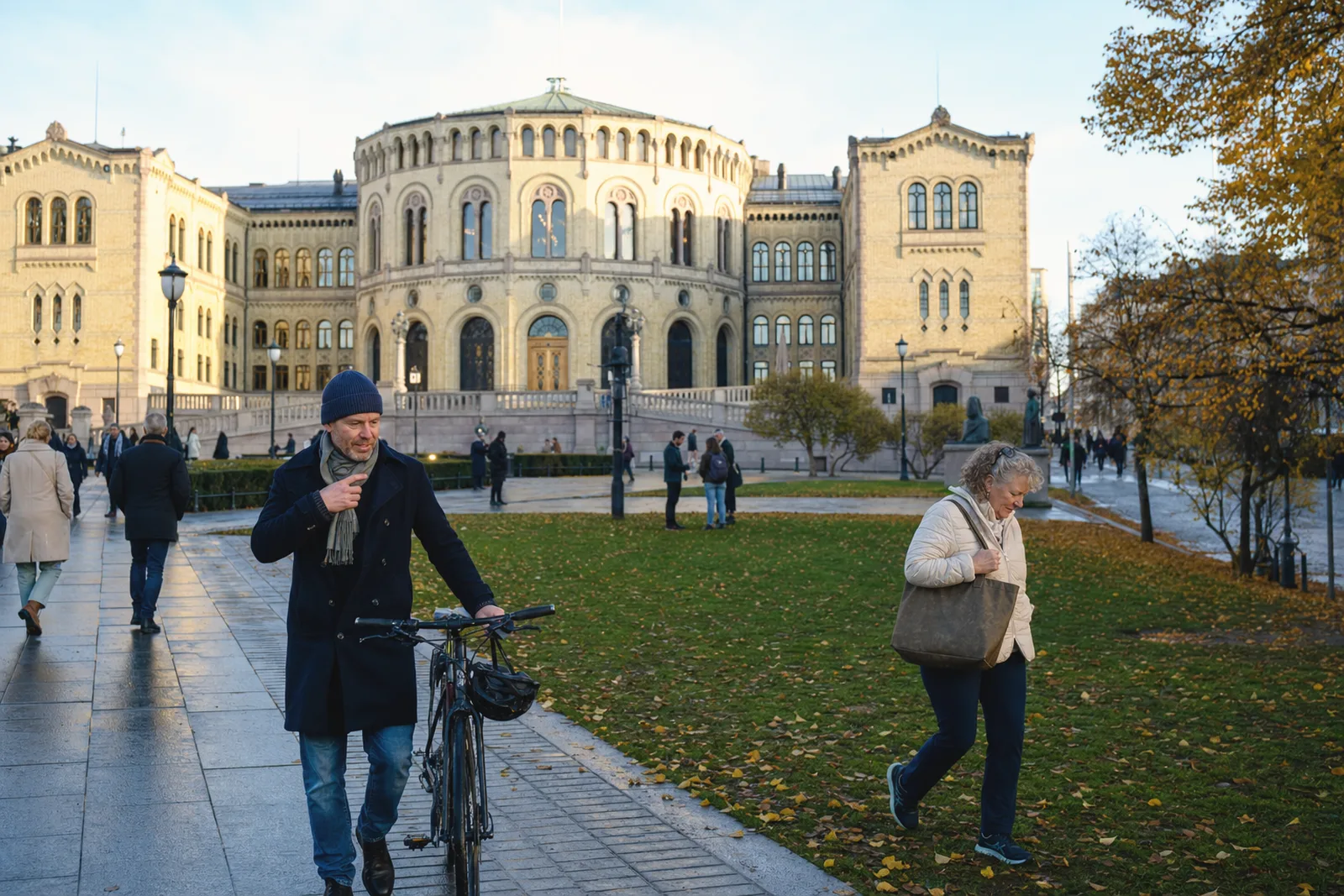
The rule-of-law state is a fundamental principle of democracy. It ensures that the authorities are bound by law, and that citizens have the right to fair treatment. Power is divided between the Storting (the Norwegian Parliament), the government and the courts, and under the Constitution of Norway (Grunnloven) § 89 the courts have the right and duty to review whether statutes and other decisions conflict with the Constitution.
Source: Government.no, Store norske leksikon, Lovdata (the Constitution of Norway (Grunnloven))
Answers to what people most often wonder about the rule of law, with the law step by step and the experiences of our members.
Rules and advice

Rules and advice

Rules and advice

Rules and advice

Rules and advice
A state governed by the rule of law is a state in which power is bound by legal rules. That sounds self-evident, but historically it is a new idea. The Constitution of Norway (Grunnloven) of 1814 was based on the principle that the king should no longer rule at his own discretion, but according to laws adopted by elected representatives.
Today, the rule-of-law state rests on a few principles that recur in all definitions of the rule of law: the principle of legality (interference requires a legal basis, Grunnloven § 113), equality before the law (§ 98), independent courts (§ 95) and respect for human rights (§ 92). Together, they are intended to prevent anyone – including the state itself – from standing above the law.
The rule-of-law state is the framework. Due process is what the individual gets from it: protection against arbitrary decisions in their own case.
The principle of separation of powers divides the power of the state into three. The Storting (the Norwegian Parliament) is the legislative branch. The government, the ministries and the entire public administration are the executive branch. The courts are the judicial branch.
The point is mutual control. The Storting scrutinises the government. The courts can review whether decisions by the public administration are lawful, and whether laws are contrary to the Constitution of Norway (Grunnloven). And the courts must be independent: neither the Storting nor the government may instruct a judge in an individual case.
Below this level there are a number of supervisory bodies: the Parliamentary Ombud, the Office of the Auditor General of Norway, the Norwegian Bureau for the Investigation of Police Affairs, the Norwegian Criminal Cases Review Commission and the supervisory authorities. How well the rule-of-law state functions depends to a large extent on whether these bodies actually correct errors when they find them. Political responsibility for large parts of the justice sector lies with the Ministry of Justice and Public Security.
World Justice Project (WJP) is an independent organisation that each year measures how the rule of law works in more than 140 countries. In the 2025 index, Norway ranked second out of 143 countries, with Denmark in first place. In 2026, Denmark, Norway and Finland were again the top three.
The index has eight components, including constraints on government powers, absence of corruption, fundamental rights, civil justice and criminal justice. It is based on surveys of the general public and professionals. In other words, it largely measures how the system is experienced – not what happens in an individual case.
We have examined this in more detail in “Silver in the rule-of-law rankings, and a crisis of trust”. In the same year that Norway received silver, the European Court of Human Rights (ECHR) had found violations in 25 Norwegian child welfare cases, according to the Norwegian National Human Rights Institution. You can read more about this under human rights and the European Court of Human Rights.
A state governed by the rule of law can work well at the broad level and still fail in individual cases. The cases we document show some recurring patterns.
The first is power without a counterweight. In “When the power of the state meets the free will of the individual”, Dag Hauffen, the association’s oldest member, talks about more than 40 years of engagement with the question of what happens when the state’s exercise of power meets individual freedom. In “The rule-of-law state behind the façade”, lawyer Arvid Sjødin takes us behind the façade, as he has experienced it from the inside.
The second is accountability of public officials. In the interview about the power of money, economist Hans Eirik Olav raises the question of who holds those in power to account. These are his assessments, which we present as part of the debate. We raise the same question when we write that the Civil Service Act (statsansatteloven) must be amended.
The third is evidence that is not tested. In February 2026, the Baneheia Committee concluded that there were significant weaknesses throughout the criminal justice chain in the case against Viggo Kristiansen. That is one of the reasons why we have gathered the cases on miscarriages of justice and reopening.
Justice for All Norway believes that three measures would have a major effect. The first is recording all testimony in court, as the Storting already decided in 2005. The second is genuinely independent oversight of the police, the prosecuting authority and the public administration – with a duty to correct errors. The third is that the individual is given access and help early, before the case has become entrenched.
None of these requires us to build a new rule-of-law state. They require us to take the one we have seriously.
Since 2014, the Constitution of Norway (Grunnloven) has had a separate chapter on human rights. This gives the courts a clearer basis for reviewing whether laws and decisions conflict with fundamental rights. Through the Human Rights Act (menneskerettsloven), the European Convention on Human Rights (ECHR) also applies as Norwegian law, with precedence over other legislation.
This means that, in principle, a Norwegian judge can set aside a law that conflicts with the Constitution of Norway (Grunnloven) or the ECHR. In practice, this happens rarely. It is all the more important that the public administration and the courts use rights actively in everyday work – in child welfare cases, in criminal cases and in cases against the state.
A state governed by the rule of law is never finished. It must be maintained through openness, a critical press, independent supervisory bodies and citizens who speak out. That is the work Justice for All Norway wants to be part of.
The rule-of-law state is rarely noticed when it works. It is noticed when it fails: when a decision cannot be explained, when a complaint is left unresolved, or when there is no one to turn to. That is why the small control points determine whether the rule-of-law state works for the individual – the right of access to documents, the right to reasons and the right to have the case reviewed again.
Many of the cases we document are not about grand principles, but about these control points not working in one specific case. When this happens again and again, in different agencies and different parts of the country, it becomes a question of the rule-of-law state. You can read more about how this affects the individual under due process and the public administration.
If you want to understand how the rule-of-law state works in an individual case, it is natural to start with the courts and the prosecuting authority. That is where most cases concerning liberty and guilt are decided. All the articles about the rule-of-law state are listed below.
The exercise of power bound by law (the principle of legality), equality before the law, separation of powers, independent courts and respect for human rights.
That the authorities must have a legal basis in law in order to intervene against the individual. This is set out in Grunnloven § 113.
An annual index that ranks countries according to how the rule of law functions. Norway has ranked second, behind Denmark.
Yes. Under Grunnloven § 89, the courts may decline to apply a law that conflicts with the Constitution of Norway (Grunnloven).
26 articles, newest first.
The rule of law
Rules and advice
Comment

Rules and advice
Rules and advice
Rules and advice
Short episode

PFU
Book

Podcast

Podcast

News

Thomas Mathiesen

Interview
News

Gunnar Waagestad

Helge Andersen

Leif Morten Larsen

Film interview

Nikolai Vilnes

Film interview

The power of money

Helge Andersen

Hans Eirik Olav

Analysis
Arvid Sjødin