News · The courts · The courts and the judges
Two explanations for the bend at Torvdalsvatnet
In a criminal case the court itself decides which evidence it believes. After the fatal crash in Lofoten in 2015, the prosecution’s experts stood against the defence’s. The court chose the first explanation. The driver believes the trailer skidded out.
In brief
- In Norwegian criminal cases the court assesses the evidence freely: it decides for itself which evidence and which experts it gives weight to.
- Forensic medical reports are reviewed by the Norwegian Board of Forensic Medicine. Technical reconstructions of road crashes have no equivalent review.
- After the crash in Lofoten, the court, according to NRK, found that the whole articulated lorry had been in the wrong lane. The defence’s experts, among them a professor at NTNU, believed the opposite.
- Markus “Webasto” Myrvold was convicted of negligent homicide in the district court and the Court of Appeal. The judgment is final.
When a fatal crash ends up in court, the question often becomes technical: Where were the vehicles, how fast were they going, and why did the trailer skid out? Judges are not engineers. They have to rely on experts. This article explains how that works, and how it went in the case from Lofoten, part 2 of the series Brake Deaths. More on the justice system can be found under The courts.
How experts are used
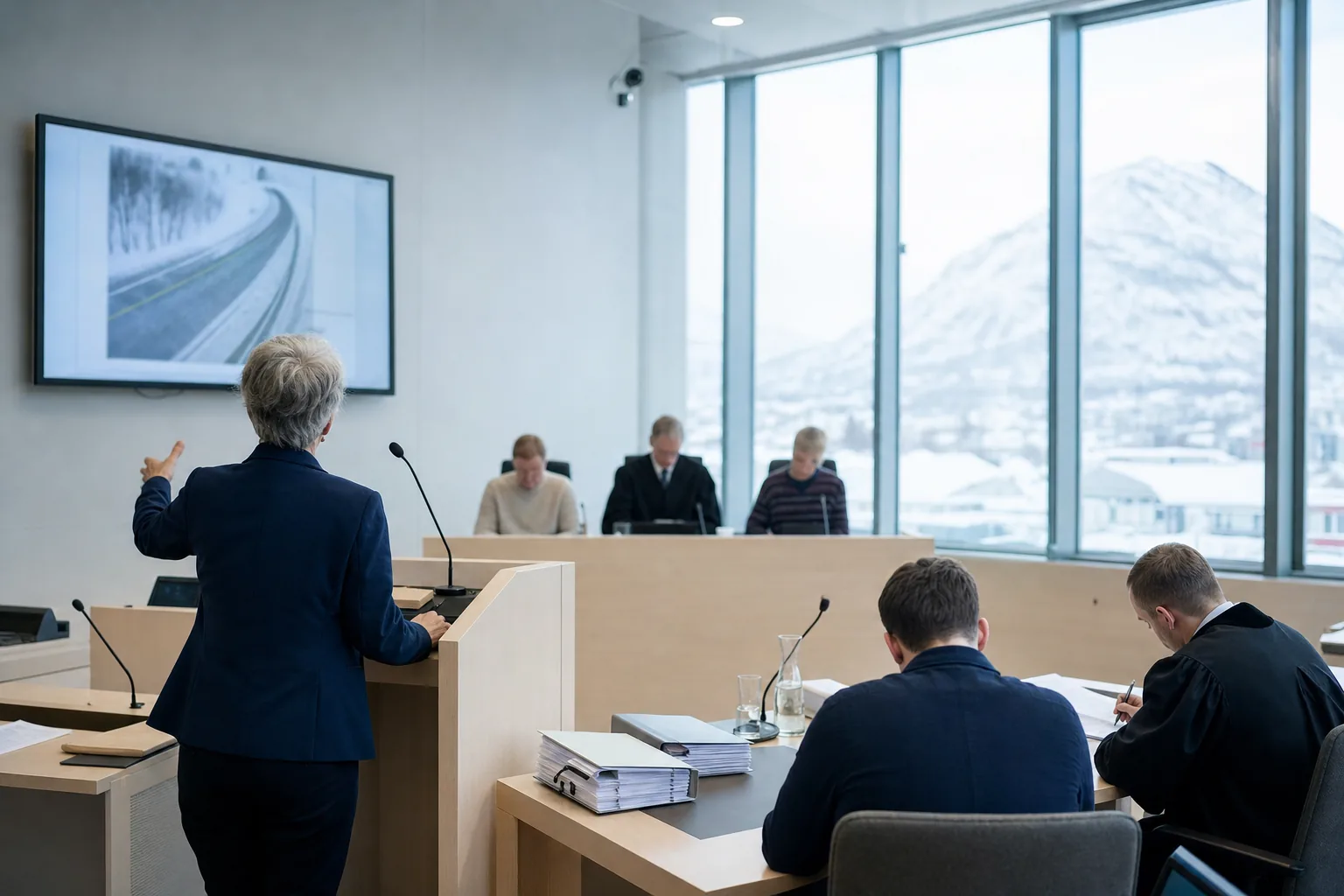
Chapter 11 of the Criminal Procedure Act governs experts in criminal cases. The court can appoint experts when it needs knowledge it does not have itself, and gives them a mandate. The prosecution and the defence can also call their own experts as witnesses. In road traffic cases these may be engineers, crash analysts or brake specialists.
The court is not bound by the experts’ conclusions. In Norwegian criminal procedure the evidence is assessed freely: the judges decide for themselves which explanations and which specialists they give weight to. At the same time, any reasonable doubt must benefit the defendant.
For some fields there is an additional check. The Norwegian Board of Forensic Medicine reviews forensic medical reports, for example on cause of death and psychiatry, and informs the court if it finds significant shortcomings. Technical reconstructions of road crashes do not fall under the board. There it is up to the other side’s experts to find the errors.
The prosecuting authority’s explanation
At Torvdalsvatnet in Lofoten an articulated lorry collided with a car on 2 July 2015. The driver of the car, a mother, was killed. The prosecution argued that the lorry driver, Markus “Webasto” Myrvold, had been in the wrong lane on the bend, seen the car coming and steered the lorry back – so abruptly that the trailer swung out.
According to NRK, investigations by the Norwegian Public Roads Administration and an expert from Rekon, a firm that reconstructs crashes, supported this explanation. Lofoten District Court convicted Myrvold of negligent homicide in 2016. Hålogaland Court of Appeal reached the same result and found that he steered to get the whole lorry back into the right lane.
The defence’s explanation
The defence’s experts, among them a professor at NTNU, believed the opposite: that the scenario the court relied on was the least logical one, and that overbraking can happen even with approved brakes. In the Court of Appeal the professor found, according to Myrvold, an error in the figures Rekon had used. The judgment nevertheless stood.
Myrvold was driving at 61 kilometres per hour where the speed limit was 80. In his account the trailer was where it should be when he checked the mirror before the bend. He believes it skidded out when he braked, and that it was knocked back into place in the collision. The only eyewitness was in the car behind and explained, according to Myrvold, that the whole trailer lay across the road.
They would not listen to the only witness, they would not listen to my experts either in the district court or the court of appeal.
Seven years after the crash, the Rekon expert told NRK that he was less certain than before, and that the braking balance should have been better documented. What the workshop inspection the week before the crash showed, we have written about in Approved one week before the fatal accident.
We sat and talked, but no one wanted to listen to us.
In June 2023 the lawyer Sigurd Klomsæt submitted a petition to reopen the case with new technical assessments. According to Klomsæt it has been rejected; we have not seen the decision. How a final judgment can be reviewed is shown by the case from Drivdalen: Convicted over a fatal crash – acquitted 13 years later.
Read more about Markus’ case here: “A week earlier the lorry had been approved”. The story is about the fatal crash in Lofoten in 2015, the conviction for negligent homicide and the brake inspection the week before.
Supporting members
Support Justice for All Norway from abroad
Membership of the association is open to people living in Norway. International supporting memberships are on their way, so that you can support our work wherever you live.
Become a supporting memberComing soonRead more
- Part 2: “A week earlier the articulated lorry had been approved” – Markus “Webasto” Myrvold on the fatal accident in Lofoten
- Part 1: The man who would not give up – the whistleblower Helge Andersen and the brake tests
- Part 3: The lawyer who drove an articulated lorry – Sigurd Klomsæt on the drivers who are blamed
- More articles on the case: Approved one week before the fatal accident · Who is responsible when the brakes fail? · – I know what kind of hell is waiting
- From part 1: How the roller brake test works – and the criticism · Convicted over a fatal crash – acquitted 13 years later
- Topic pages: Brake Deaths · The courts · Public administration and NAV
- The film interviews: Markus’ story · Helge Andersen: Brake Deaths · Gunnar Waagestad
- NRK Brennpunkt: “Kollisjon” (Collision, NRK TV, in Norwegian)
- Become a supporting memberComing soon
Sources
- Criminal Procedure Act, chapter 11 on experts (Lovdata)
- Norwegian Directorate of Health: The Criminal Procedure Act and the Norwegian Board of Forensic Medicine (sections 146–147)
- Penal Code (straffeloven) § 281 on negligent homicide (Lovdata)
- NRK (19.12.2022): Lorry driver convicted of negligent homicide. But what if it was the articulated lorry’s fault, not the driver’s?
- Nordlys: Tromsø man convicted of negligent homicide of mother of two after traffic accident (Lofoten district court)
- NRK (12.6.2023): Applies for reopening after Markus Myrvold was convicted of homicide
- NRK Brennpunkt: “Kollisjon” (12.10.2022)
- Justice for All Norway: Brake failure, fatalities and miscarriages of justice – Markus’ story (film interview, Dec. 2025)
- Justice for All Norway: Topic Brake Deaths
Quotes translated from Norwegian.
Published 21 November 2026 at 12:00 · Updated 21.11.2026
About AI in our articlesSupporting members
Support Justice for All Norway from abroad
Membership of the association is open to people living in Norway. International supporting memberships are on their way, so that you can support our work wherever you live.
Become a supporting memberComing soon