News · Explained · The courts and the judges
How the roller brake test works – and the criticism
Every lorry, bus and large trailer must pass a brake test on rollers in the floor. The Norwegian Public Roads Administration says it is the best method there is. The whistleblower Helge Andersen says it never gives the same answer twice.
In brief
- The roller brake test measures braking force wheel by wheel while the wheels are turned at low speed.
- For heavy vehicles it is in practice the only brake inspection used at the roadworthiness test (EU-kontroll) and at roadside inspections.
- The Norwegian Public Roads Administration and the transport minister consider it the best method, though it “may still give some minor variations”.
- Helge Andersen believes the test gives different answers for the same vehicle, and that alterations after faulty measurements can make lorries dangerous.
- The interaction between vehicle and trailer is not inspected today, the Public Roads Administration has told NRK.
If you are driving behind an articulated lorry on an icy road, you trust that its brakes have been inspected. They have – on a roller brake tester. That is also the inspection the whistleblower Helge Andersen has criticised for more than 20 years, as we tell in the main story The man who would not give up. Everything about the series is on the topic page Brake Deaths, and more on dealing with public agencies is under Public administration and NAV.
How the test is done
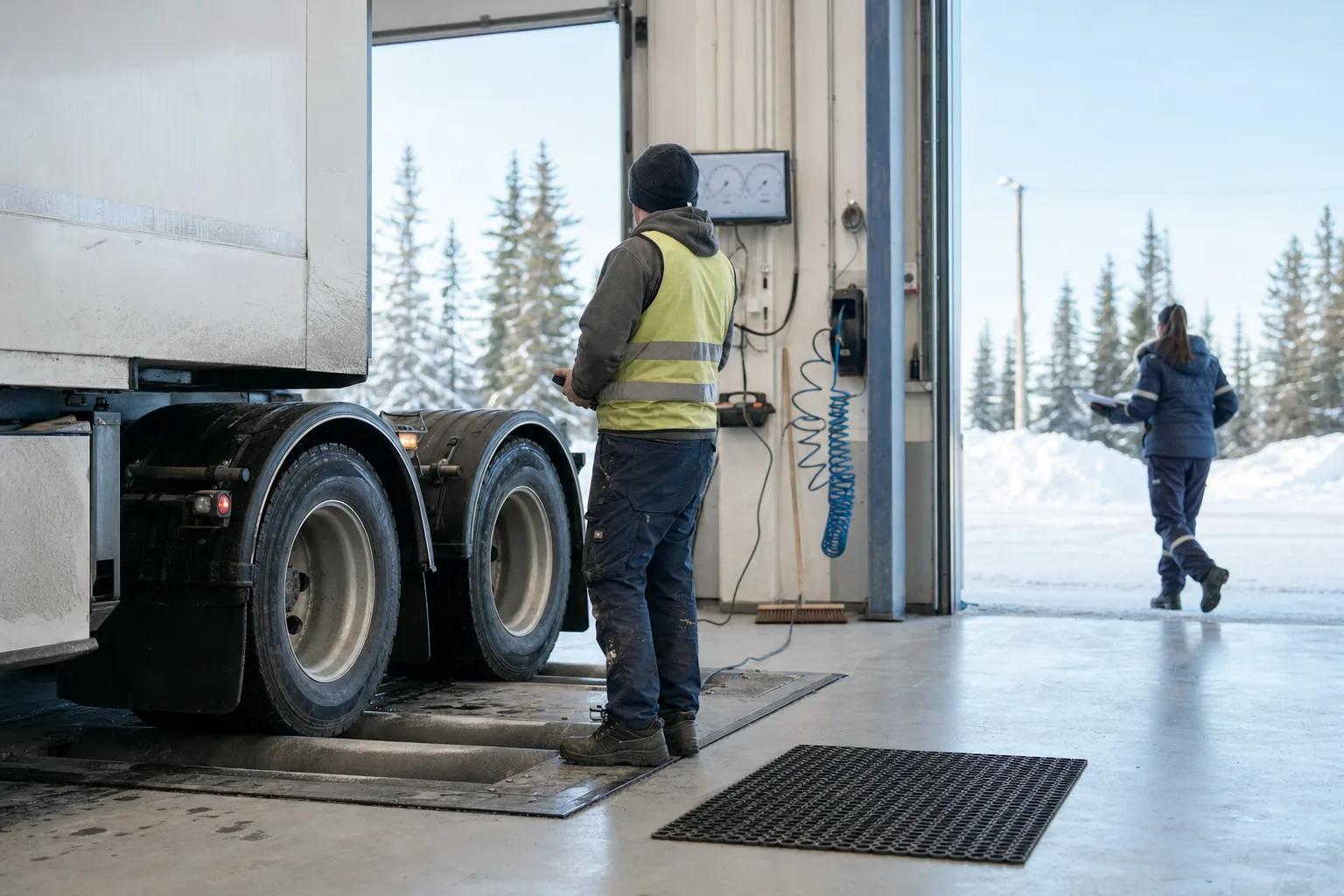
The roller tester consists of two steel rollers per axle, set into the floor at inspection stations and garages. The vehicle is driven on, the rollers turn the wheels, and the inspector presses the brake. The instrument shows the braking force on each wheel. From the figures, it is calculated whether the vehicle will stop safely out on the road.
In the film interview with Justice for All Norway, Andersen describes the speed like this:
About 2.5 km an hour, as fast as a fairly elderly pensioner strolls along the pavement.
Heavy vehicles must have a roadworthiness test every year. In addition, the Norwegian Public Roads Administration inspects heavy vehicles at the roadside. According to NRK, around 470,000 heavy vehicles passed the inspection stations in 2021. Almost 80,000 were inspected, and 23,000 were not allowed to continue until faults had been put right.
The criticism
Andersen believes low speed is the heart of the problem. At walking pace the vehicle’s own safety systems, such as ABS, are not working as they do on the road. He also believes the results vary from test to test:
But here the results jump and bounce in all directions.
NRK has documented the same phenomenon: a trailer that got three different brake results on the same day. The most serious thing, according to Andersen, is what happens afterwards. If the test shows brakes that are too weak on a trailer that works, it is altered. The trailer may then brake harder than the vehicle, lock its wheels and swing out to the side on a slippery road. That is the background to the word the drivers in the series use: “bremsedrap”, brake deaths.
The brake distribution between vehicle and trailer is not inspected. “We do not have methods today that can check every single vehicle”, the Norwegian Public Roads Administration’s director of roadside inspections told NRK in 2022. What the Safety Investigation Authority has found in crashes involving articulated lorries is collected in Four crashes, three warnings.
The authorities’ answer
In January 2023 the transport minister told the Storting that there is “broad professional agreement internationally that roller brake testers are the best method”. Inspection results have improved considerably, he wrote, “even though the method may still give some minor variations”. The Norwegian Public Roads Administration is open to considering other inspection methods, but within international rules and European standards.
Andersen developed an alternative himself, Kombimatic, which was meant to quality-assure the roller tests. How that went is told in He gave the idea to the suggestion box. Then he was moved. If you are a driver and disagree with a brake inspection, see Vehicle taken off the road after a brake test? What you can do. Whether the brakes also matter in criminal cases is the subject of Convicted over a fatal crash – acquitted 13 years later.
Read more about Helge’s case here: The man who would not give up. The story is about the brake tests on articulated lorries, his warnings inside the Norwegian Public Roads Administration and what speaking up has cost him.
Read more
- The main story: The man who would not give up – Helge Andersen and the brake tests
- Part 2: “A week earlier the articulated lorry had been approved” – Markus “Webasto” Myrvold on the fatal accident in Lofoten
- Part 3: The lawyer who drove an articulated lorry – Sigurd Klomsæt on the drivers who are blamed
- Topic pages: Brake Deaths · Whistleblowing and whistleblowers · The courts · The public administration and NAV
- More articles in the series: Four crashes, three warnings · Convicted over a fatal crash – acquitted 13 years later · He gave the idea to the suggestion box. Then he was moved · Vehicle taken off the road after a brake test? What you can do
- The film interviews: Helge Andersen: Brake Deaths · Brake Deaths part 2 · Markus’ story · Gunnar Waagestad
- NRK Brennpunkt: “Kollisjon” (Collision, NRK TV, in Norwegian)
- Become a supporting memberComing soon
Sources
- Justice for All Norway: Helge Andersen – Brake Deaths (film interview, October 2025)
- Storting, Document 15:762 (2022–2023) (in Norwegian)
- NRK (8 November 2022): Fatal crashes on Norwegian roads may be caused by faults in lorry brakes (in Norwegian)
- NRK: The trailer got three different brake results on the same day (in Norwegian)
- NRK Brennpunkt: Kollisjon (Collision)
- Norwegian Public Roads Administration: Roadworthiness test (EU-kontroll)
- Lovdata: Vehicle Regulations (kjøretøyforskriften)
Quotes translated from Norwegian.
Published 20 November 2026 at 14:01 · Updated 20.11.2026
About AI in our articlesSupporting members
Support Justice for All Norway from abroad
Membership of the association is open to people living in Norway. International supporting memberships are on their way, so that you can support our work wherever you live.
Become a supporting memberComing soon