News · Rules and advice · The courts and the judges
Audio recordings in Norwegian courts: what is recorded, and what is not?
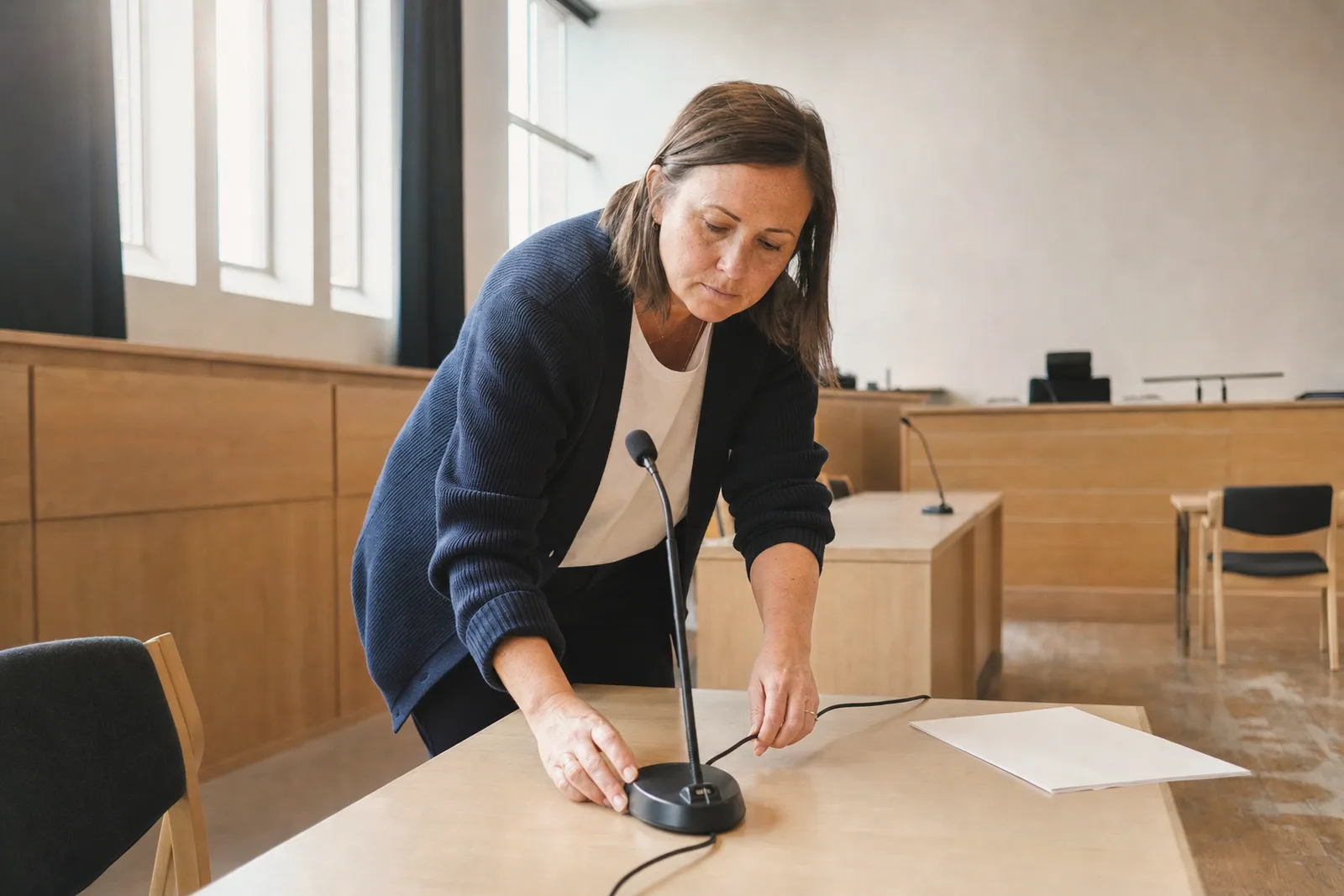
The law says that testimony from parties, witnesses and expert witnesses must be recorded during main hearings and appeal hearings. But the court may refrain from doing so when it lacks the equipment, and closing submissions, opening statements and the court’s deliberations are not covered. Here are the rules, how you can gain access to the recordings, and what our members have experienced.
In brief
- During main hearings and appeal hearings, testimony from parties, witnesses and expert witnesses must be recorded, both in civil cases and in criminal cases (the Dispute Act (tvisteloven) § 13-7 and the Criminal Procedure Act (straffeprosessloven) § 23).
- Recordings may be omitted when the court does not have the necessary equipment, or when the testimony is instead entered in the court record.
- Closing submissions, opening statements and the court’s deliberations are not covered by the duty to record, unless the court decides otherwise.
- The parties have the right to borrow the recordings in the same way as they have access to the rest of the case documents. The same applies to the person who has given testimony.
- Photography, filming and recording for radio and television are prohibited during hearings in criminal cases, unless the court makes an exception (the Courts of Justice Act (domstolloven) § 131 a).
The short answer is that audio recordings in court must be made of testimony, but not of everything. Since 2018, the law has required that testimony from parties, witnesses and experts be recorded during main hearings and appeal hearings. The court may still refrain from doing so when it does not have the equipment, and what is said by lawyers, prosecutors and judges is not covered. This guide explains what is recorded, how you can gain access, and what you are allowed to do yourself. It is part of the topic page on the courts and the judges.
The first part explains what the law says. The second part concerns what members of Justice for All Norway have experienced when there has been disagreement about what was actually said.
These are the rules
What must be recorded?
In civil cases, the Dispute Act § 13-7 says that recordings must be made of statements by parties and witnesses during main hearings and appeal hearings. In criminal cases, the Criminal Procedure Act § 23 says the same about testimony from parties, witnesses and expert witnesses. In both types of case, the court may decide that other parts of the hearings and other court sittings must also be recorded.
The recordings are part of the court record and are archived together with the case. The person giving testimony must be notified that their testimony will be recorded. This means that, as a witness or party, you must be told before you start speaking.
When may recordings be omitted?
The law provides two exceptions. Recordings may be omitted when the court does not have the necessary equipment, and when the testimony is instead entered in the court record. In civil cases, recordings may also be omitted in small claims proceedings (the Dispute Act Chapter 10). If no recording has been made, it is the court record that documents the hearing. In criminal cases, it must contain the parties’ claims, applications and objections and the court’s decisions (the Criminal Procedure Act § 19). As a general rule, the testimony itself is not written down during the main hearing.
There are nevertheless special cases in which testimony may or should be entered in the court record. During the main hearing, the court may decide this, among other things, when the testimony differs on material points from earlier testimony. When there is reason to believe that a statement may entail criminal liability for false testimony or accusation, it should be entered in full and, as far as possible, in the person’s own words (the Criminal Procedure Act § 21 and § 22). Outside the main hearing, for example in custody hearings, testimony must be entered in the court record and read aloud (§ 20).
What is not recorded?
- Closing arguments and opening statements by lawyers and the prosecutor, unless the court decides that these too are to be recorded.
- The court’s deliberations when the judges withdraw to consider the case. They are always closed.
- Preparatory court meetings, for example planning meetings, unless the court decides otherwise. The court record must show, among other things, applications, objections and the court’s decisions or orders (the Dispute Act § 13-6).
If you believe that something said in a closing argument misrepresents testimony, it is important to say so in court at once, and to ask for the objection to be entered in the court record.
This is how you gain access to the recording
The parties have the same right to be lent recordings as they have to access the rest of the court’s case documents. Anyone whose testimony has been recorded has the same right (the Dispute Act section 13-7 fourth paragraph and the Criminal Procedure Act section 23). You may wish to ask the court for the recording in writing, stating the case number, the date and which testimonies you want. If you have a lawyer, the lawyer can ask for it on your behalf. The recording can be transcribed, either by the court or by the parties.
The recordings are particularly important on appeal. The court of appeal can use them, and in civil cases regulations may provide that recordings are played instead of the witness giving testimony again (the Dispute Act section 24-1 fourth paragraph).
Are you allowed to make your own recording in court?
In criminal cases, photography, filming and recording for radio or television are prohibited during the proceedings (the Courts of Justice Act section 131 a). If special reasons support it, the court may, during the main hearing, make an exception to the prohibition where it cannot be assumed to have an adverse effect on the handling of the case, and where no other considerations speak decisively against it. Before permission is granted, the parties must have the opportunity to comment. It is also prohibited to photograph the person charged on the way to or from the court hearing without consent. Private audio recordings for personal use are not directly covered by the prohibition in the Courts of Justice Act section 131 a, but the court may prohibit recording under the Courts of Justice Act section 133. If you want to make your own audio recordings in the courtroom, you should therefore ask the court in advance.
If you are to give testimony as a witness, you can read more in the guide Witness in court: duties, rights and what you can refuse. How the district court works is explained in What is the district court, and what cases does it hear?. In parental dispute cases, documentation of testimony can be highly significant. Read the guide to parental dispute cases.
Are you involved in a case where there is disagreement about what was said? Become a supporting member – coming soon.
This is our members’ experience
Many members of Justice for All Norway tell us about cases in which there has later been disagreement about what a witness actually said. That is their experience, not a documented truth about all cases. But it shows why recordings matter so much for due process.
Øystein Flenning is a law graduate, was the director of a large arena in Oslo and is today deputy chair of Justice for All Norway. He was stabbed and was later himself convicted of violence in the same incident. He describes himself as wrongfully convicted. The judgment stands unless and until it is overturned. In the film interview with Justice for All Norway, he describes documentation of what is said in court as the most important measure for strengthening due process.
In his experience, the lack of documentation of what is said in court is highly problematic. In Flenning’s view, there should be both sound and video in courtrooms, and he is critical of the fact that it has taken so long. As he experienced it, audio recording had still not been introduced in Norwegian courts.
That is his description of the experience from his own case. Since 2018, the statutory text has required recordings of testimony, but with an exception when the court lacks equipment. The extent to which the equipment has been in place has varied between the courts. The gap between the statutory text and what Flenning has experienced is precisely what many members describe.
The same question applies to police interviews. In the episode The K.R.E.A.T.I.V. method (KREATIV interview model) versus reality, Vigdis Bollerud, a former police investigator and chair of Justice for All Norway, goes through the Director of Public Prosecutions’ circular on police interviews. According to her account, the circular provides for the use of audio recording in all police interviews where possible, and for the absence of a recording to be justified. Bollerud’s advice to members who are summoned for police interview is to make sure that the interview is audio-recorded.
She points out that it is covert recording of conversations between others that is punishable (the Penal Code (straffeloven) section 205), not recording a conversation in which you yourself take part. Note that the rules in the courtroom are stricter than in a police interview; see the section on the Courts of Justice Act section 131 a above.
Our members have learned three things: ask for the recording as soon as the hearing is over, compare it with what is stated in the judgment, and say so at once in court if testimony is misrepresented.
Would you like help and a community? Become a supporting member – coming soon. As a member, you get access to the tools in the members’ area and to groups with people who have been through the same thing.
Frequently asked questions
Does the district court make audio recordings of court cases?
During the main hearing, testimony from parties, witnesses and experts must be recorded (the Dispute Act section 13-7 and the Criminal Procedure Act section 23). The court may omit this when it does not have the necessary equipment, when the testimony is entered in the court record, and in civil small claims cases. Closing arguments and opening statements are recorded only if the court decides so.
Can you get a copy of the audio recording from a court case?
The parties have the same right to borrow recordings as they have to access the rest of the court’s case documents. Anyone whose testimony has been recorded has the same right (the Dispute Act section 13-7 fourth paragraph and the Criminal Procedure Act section 23). You may wish to ask the court for the recording in writing, stating the case number, the date and which testimonies you need.
Are you allowed to make a private audio recording in court?
Private audio recordings for personal use are not directly covered by the prohibition in the Courts of Justice Act section 131 a, but the court may prohibit recording under the Courts of Justice Act section 133. You should therefore clear this with the court in advance. If the recording is to be published, or if it is a recording for radio or television in a criminal case, the prohibition and the exception rules in the Courts of Justice Act section 131 a apply.
Can audio recordings be used as evidence in court?
Yes, as a general rule. Norwegian law is based on the free presentation of evidence, and an audio recording may be submitted as evidence in both civil and criminal cases. The court may in special cases refuse evidence, for example where it has been obtained in an improper manner. Recording a conversation in which you yourself have taken part is not punishable under the Penal Code (straffeloven) section 205.
Sources
- Lovdata: the Dispute Act section 13-7 – recording of parties’ and witnesses’ testimony
- Lovdata: the Criminal Procedure Act section 23 – recording of testimony
- Lovdata: the Criminal Procedure Act sections 19–22 – the court record
- Lovdata: the Courts of Justice Act section 131 a – prohibition on photography and recording
- Lovdata: the Penal Code (straffeloven) section 205 – violation of the right to private communication
- Justice for All Norway: Øystein Flenning – From victim of violence to wrongfully convicted (film interview)
- Justice for All Norway: The K.R.E.A.T.I.V. method against reality, episode 1 of 5 (Vigdis Bollerud)
- Fact check: the legal references have been checked against Lovdata’s open data (current acts, retrieved 15 November 2026), and the other information against official online sources on 20 November 2026.
Published 20 November 2026 · Last updated 20 November 2026
About AI in our articlesSupporting members
Support Justice for All Norway from abroad
Membership of the association is open to people living in Norway. International supporting memberships are on their way, so that you can support our work wherever you live.
Become a supporting memberComing soon