News · Child interviews
When your child has been interviewed by the police: who is present – and what are the parents told?
When a child under 16 has to give evidence about violence or abuse, it happens in a facilitated interview at a Children's House (Statens barnehus). The child welfare service and the guardian may follow the interview from another room, but the interview leader can say no. This is what the law says about who is present, the deadlines – and the right to see the recording afterwards.
In brief
- Witnesses under 16 must be interviewed in a facilitated interview in cases concerning, among other things, sexual offences and domestic violence (Criminal Procedure Act, section 239).
- The interview is recorded on video (section 239 a). In 2024, 4,392 facilitated interviews were carried out at the Children's Houses.
- The child's counsel must follow the interview. The child welfare service and the guardian may follow it, unless the interview leader considers that the interests of the child or of the investigation weigh against it (section 239 d).
- The child is the aggrieved party. Through the guardian and the child's counsel, the child may ask for access to the case documents, provided this does not harm the investigation or others (section 242).
- The deadline for the interview is one to three weeks, depending on the case (section 239 e).
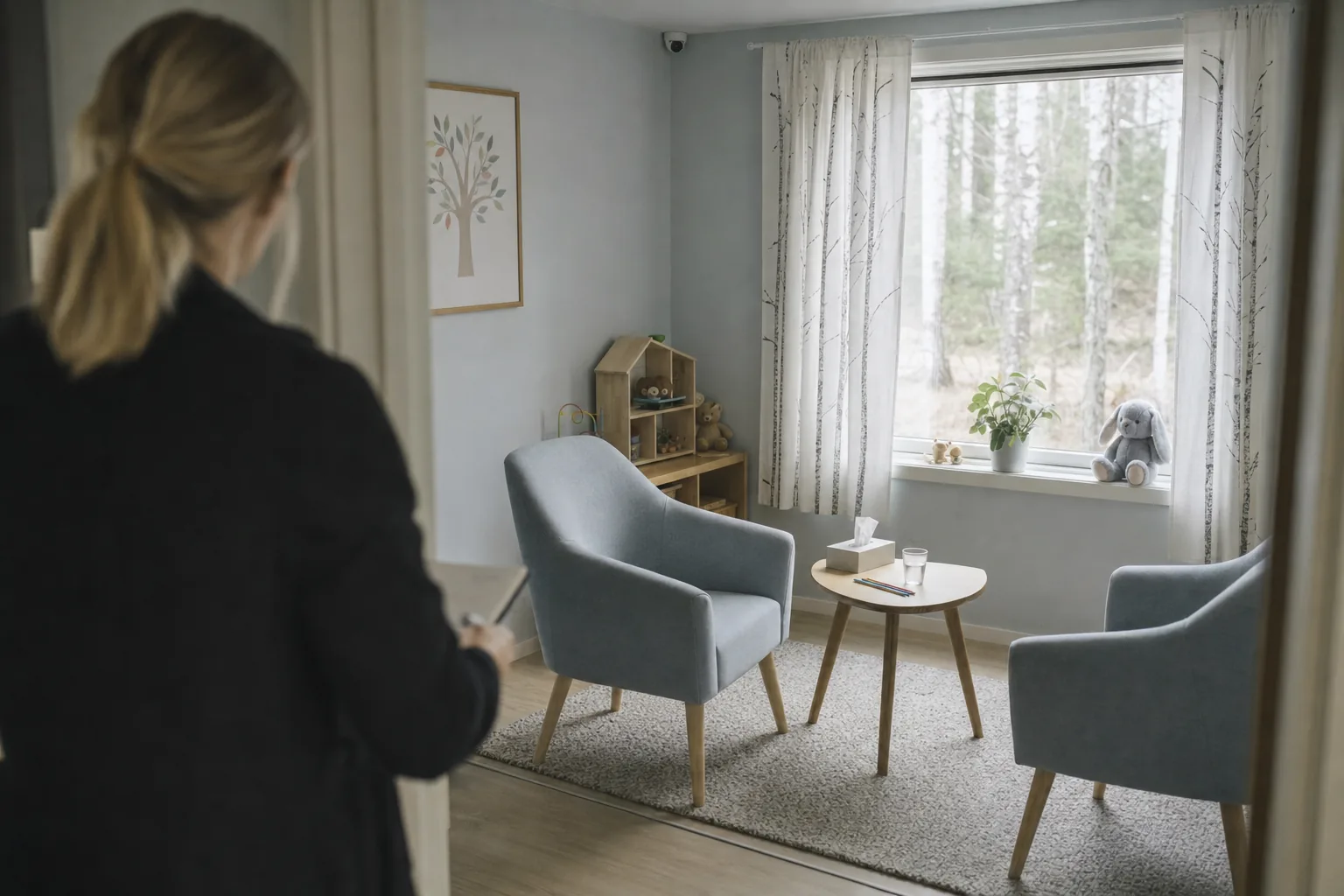
A facilitated interview is a police interview of a child, carried out as gently as possible. It takes place at one of the Children's Houses, in a room designed for children, and it is led by a police lawyer. A specially trained police investigator asks the questions. The recording can later be used as evidence in court instead of the child having to testify.
In 2024, 4,392 facilitated interviews were carried out at the twelve Children's Houses. This is shown in their annual report. The Children's Houses work with the child welfare service both before the interview and in the follow-up afterwards.
Before and after the interview
The regulations on facilitated interviews require a consultation meeting before the interview and a follow-up meeting afterwards. The guardian, the child's counsel and the child welfare service must be allowed to take part, unless there are strong reasons against it. The follow-up meeting must discuss who is to follow up the child, and when the child welfare service is to talk to the child about the case. The interview leader may impose a duty of confidentiality on everyone who has followed the interview.
The regulations contain no specific rule on what the parents are to be told after the interview. This means that a parent who is not a suspect may be left with whatever the child welfare service or the police tell them orally. The right to see the recording itself runs through section 242 of the Criminal Procedure Act: the aggrieved party and their counsel must, on request, be allowed to see the case documents, provided this does not harm the investigation or a third party.
Lillian Gran's case
Lillian Gran reported what the children had told her to the police on 22 December 2020. Around three weeks passed before the children were interviewed in January 2021. She was not present. The child welfare service followed the interview. When she collected the children, she was told that they had not said anything.
She did not know she could ask for access. Only during the case before the tribunal in 2022 did she see the recordings. Whether the children have been abused, and if so by whom, has not been established.
I didn't even know what access to documents was.
The whole story is in the chapter on what the children said in the interview. We have written about what applies when a restraining order follows in Restraining orders against your own children: what applies when the child calls?.
This is one of four articles that belong to Lion Mum, the story of Lillian Gran. The chapter on what the children said in the interview is closely linked to what you are reading here. The story has six chapters, from the separation in 2014 to her remand in custody in December 2025.
What can you do?
- Ask who will follow the interview, and whether you, as guardian, can be one of them.
- Ask for counsel for the child. The child's counsel must follow the interview and may suggest questions.
- Ask for access in writing under section 242 of the Criminal Procedure Act – including the video recording. A refusal can be brought before the court.
- Ask for written minutes of the follow-up meeting: what was agreed about the follow-up of the child?
- Note the dates of the police report and the interview. The deadlines in section 239 e run from the report.
Watch the filmed interview: Lillian Gran versus the child welfare service: Lion Mum (88 minutes). The film is also embedded in the main story.
Open questions
- How often do parents who are not suspects get to see the recordings of their children's interviews?
- How often does the child welfare service follow the interview, and who informs the parents afterwards?
- How many interviews are held after the deadline in section 239 e?
Has your child been interviewed at a Children's House? Become a supporting memberComing soon, and you can share your experience with us.
Supporting members
Support Justice for All Norway from abroad
Membership of the association is open to people living in Norway. International supporting memberships are on their way, so that you can support our work wherever you live.
Become a supporting memberComing soonRead more
- The main story: Lion Mum – chapter 2: What the children said in the interview · chapter 3: She won before the tribunal · chapter 4: The children who were not asked · chapter 5: Custody
- The series: When the family moves in the middle of a child welfare case: which municipality is responsible?
- The series: From a bullying complaint to a child welfare case: when parents complain about the school environment
- The series: Restraining orders against your own children: what applies when the child calls?
- The Lillian Gran case: The filmed interview “Lion Mum” · The lawyer Erik Bryn Tvedt · The private investigator Thomas Mathiesen · The case review
- More stories: Who controls the child welfare service's discretion? · Children who speak up are entitled to be taken seriously · Found in breach 25 times in Strasbourg
- Topic pages: Child welfare · Norway in Strasbourg
- Become a supporting memberComing soon
Sources
Quotes translated from Norwegian.
Published 27 November 2026 at 14:30 · Updated 27.11.2026
About AI in our articlesSupporting members
Support Justice for All Norway from abroad
Membership of the association is open to people living in Norway. International supporting memberships are on their way, so that you can support our work wherever you live.
Become a supporting memberComing soon