News · Rules and advice
What happens in the courtroom? A civil case from writ of summons to judgment
Many people have never been in a courtroom before they stand in their own case. Here is how a civil case proceeds from writ of summons to judgment: the preparation, the hearings, the evidence of the parties, the witnesses, the closing speeches – and what you can do to be prepared.
In brief
- A civil case starts with a writ of summons and a defence.
- During preparation the judge plans the case together with the lawyers, often in a planning meeting.
- The main hearing begins with opening statements, then the parties’ evidence, witnesses, documentary evidence and closing speeches.
- The law says testimony must be recorded, but many courtrooms still lack the equipment.
- The judgment usually comes in writing a few weeks after the main hearing.
A lawsuit can seem frightening. You do not know where to sit, when to speak, or what the judge expects. It is easier when you know how it works. This guide goes through an ordinary civil case from writ of summons to judgment. It belongs to the section on the courtroom and the public authorities on the topic page on lawyers. More on the courts is in what is the district court? and on the topic page on the courts.
These are the rules
The Dispute Act governs civil cases. The case starts with the claimant sending a writ of summons to the district court, with the claim, the facts and the evidence. The defendant responds with a defence. The court must then actively plan the proceedings, often in a planning meeting with the lawyers, and set deadlines for pleadings, the list of evidence and closing submissions. The main hearing is the oral trial. Section 13-7 of the Dispute Act says that the evidence of parties and witnesses at the main hearing must be recorded, but the law has an exception when the court lacks equipment. See audio recording in Norwegian courts.
Before the main hearing
In the weeks before the main hearing, a bundle of the most important documents is prepared, and both sides send a list of the witnesses and documents they wish to present. The court may hold a hearing to attempt mediation. Many cases end in settlement at this stage. Go through your evidence as a party with your lawyer. You must say what you know, in your own words. The lawyer cannot put words into your mouth, but she can help you stick to what matters. See documents for your lawyer.
In the courtroom
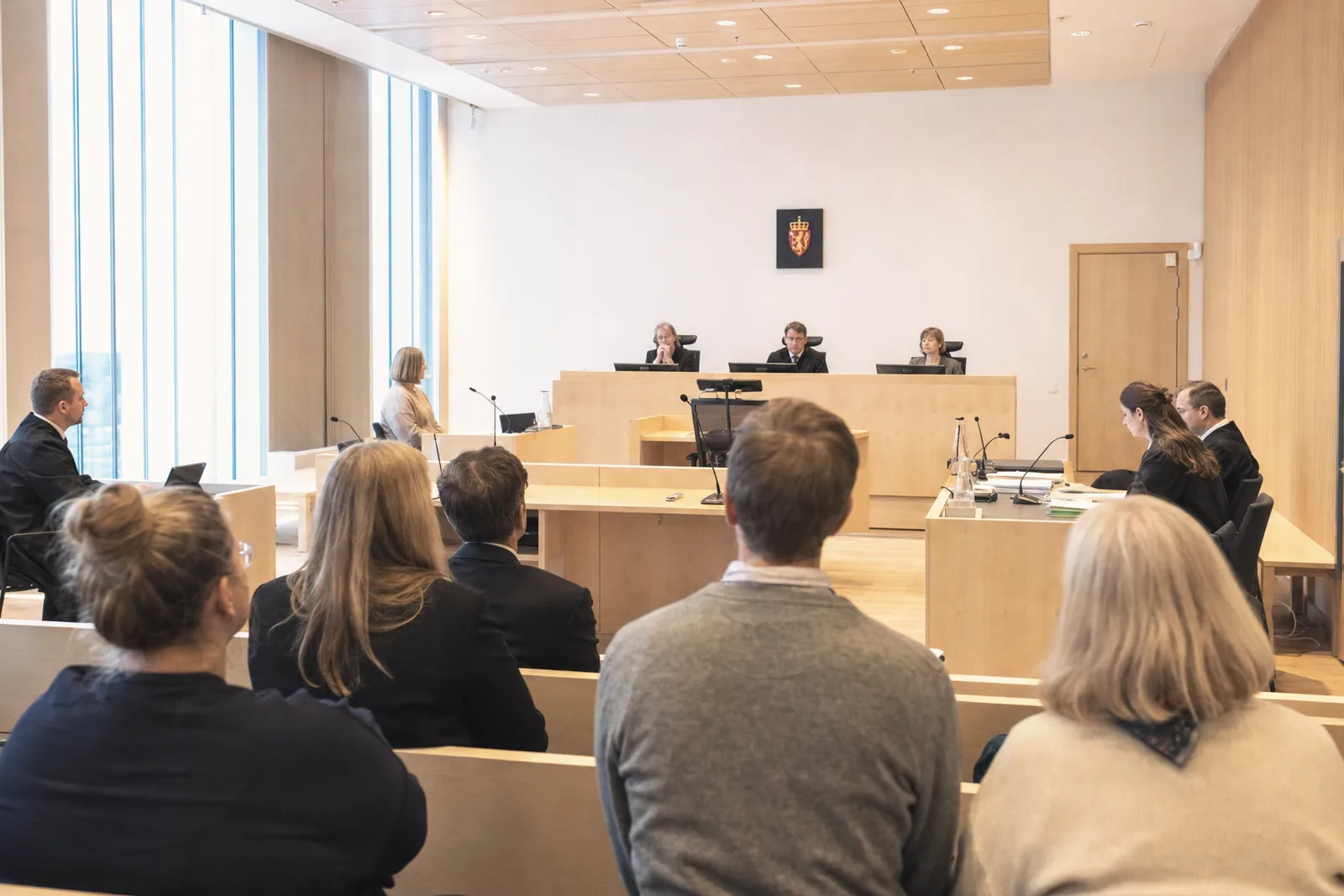
In the district court there is usually one professional judge, in some cases with two lay judges. The parties sit with their lawyers on either side. When the case starts, the claimant’s lawyer makes an opening statement explaining the case and the claim. The other side’s lawyer then responds. Then the parties give evidence. You are questioned first by your own lawyer, then by the other side’s lawyer, and finally the judge may ask questions. Answer briefly, honestly and precisely. It is perfectly fine to say you do not remember.
Witnesses and evidence
After the parties come the witnesses. Each witness gives evidence, is questioned by both lawyers and possibly by the judge. Experts may also give evidence. The documentary evidence is reviewed, often with the lawyers referring to pages in the bundle. Under point 4.2 of the rules of good professional conduct, the case must be clarified through open and objective presentation of evidence, and the lawyer must not knowingly give incorrect or misleading information. Which evidence is presented is decided by you together with the lawyer. See should all evidence and witnesses be put before the court?.
The closing speeches and the judgment
Finally the lawyers give their closing speeches, summarising the evidence and arguing for what the court should decide. You can ask to have the closing speeches in writing. The court usually delivers its judgment in writing a few weeks later. The judgment must give reasons. If you disagree, you can appeal within one month. See how to appeal a judgment and what does a lawsuit cost?.
Practical advice
Arrive in good time. Dress smartly, but normally. Bring water, a notepad and a copy of the bundle. Write down what you want to say to the lawyer during the breaks, rather than interrupting. You may bring a support person who sits among the public, unless the case is heard behind closed doors. Many cases last several days. It is tiring, so plan for rest. See the first meeting with your lawyer.
Court mediation
Before a case goes to a main hearing, the court may offer court mediation. The mediation is led by a judge or an appointed mediator, and the aim is for the parties themselves to find a solution. Mediation is confidential, and what is said there cannot, as a rule, be used as evidence later. Many cases are resolved in this way, often in a single day, which saves both parties costs and strain. The mediator can talk to the parties separately and help them see the weaknesses of their own case. You decide yourself whether to settle. Think in advance about what matters most to you, and what you can live with.
After the judgment
When the judgment comes, read it together with your lawyer. Look at how the court has assessed the evidence and arguments, and whether anything important is not mentioned. That matters for the question of appeal. Remember that the deadline is one month from service of the judgment. Consider the legal costs too. If you disagree with them, the decision on costs can be appealed separately.
This is our members’ experience
Justice for All Norway has many members who have found that what they and the witnesses said in court was rendered differently in the judgment from how they remembered it. Without audio recordings this is hard to document. Many also say they were not prepared for how little time they had to give evidence, or for the other side’s questions. The experience in the association is that those who have practised their evidence and written down the main points find the trial less overwhelming. See the Storting decided on recording in 2005 and the topic page on the courts.
Are you going to court? Prepare together with others. Become a supporting member – coming soon.
Frequently asked questions
How does a civil lawsuit proceed?
Opening statements, the parties’ evidence, witnesses and experts, documentary evidence and finally closing speeches. The judgment usually comes in writing later.
Do I have to give evidence in court?
As a party you will normally give evidence. You are questioned by both lawyers and by the judge.
Is sound recorded in the courtroom?
The law says testimony must be recorded, but this does not apply when the court lacks the equipment, which has been common.
When will the judgment come?
Usually in writing a few weeks after the main hearing.
Sources
Published 23 November 2026 · Last updated 23 November 2026
About AI in our articlesSupporting members
Support Justice for All Norway from abroad
Membership of the association is open to people living in Norway. International supporting memberships are on their way, so that you can support our work wherever you live.
Become a supporting memberComing soon