News · Rules and advice · Property rights and land consolidation
The land consolidation court: how a land consolidation case works, and what it costs
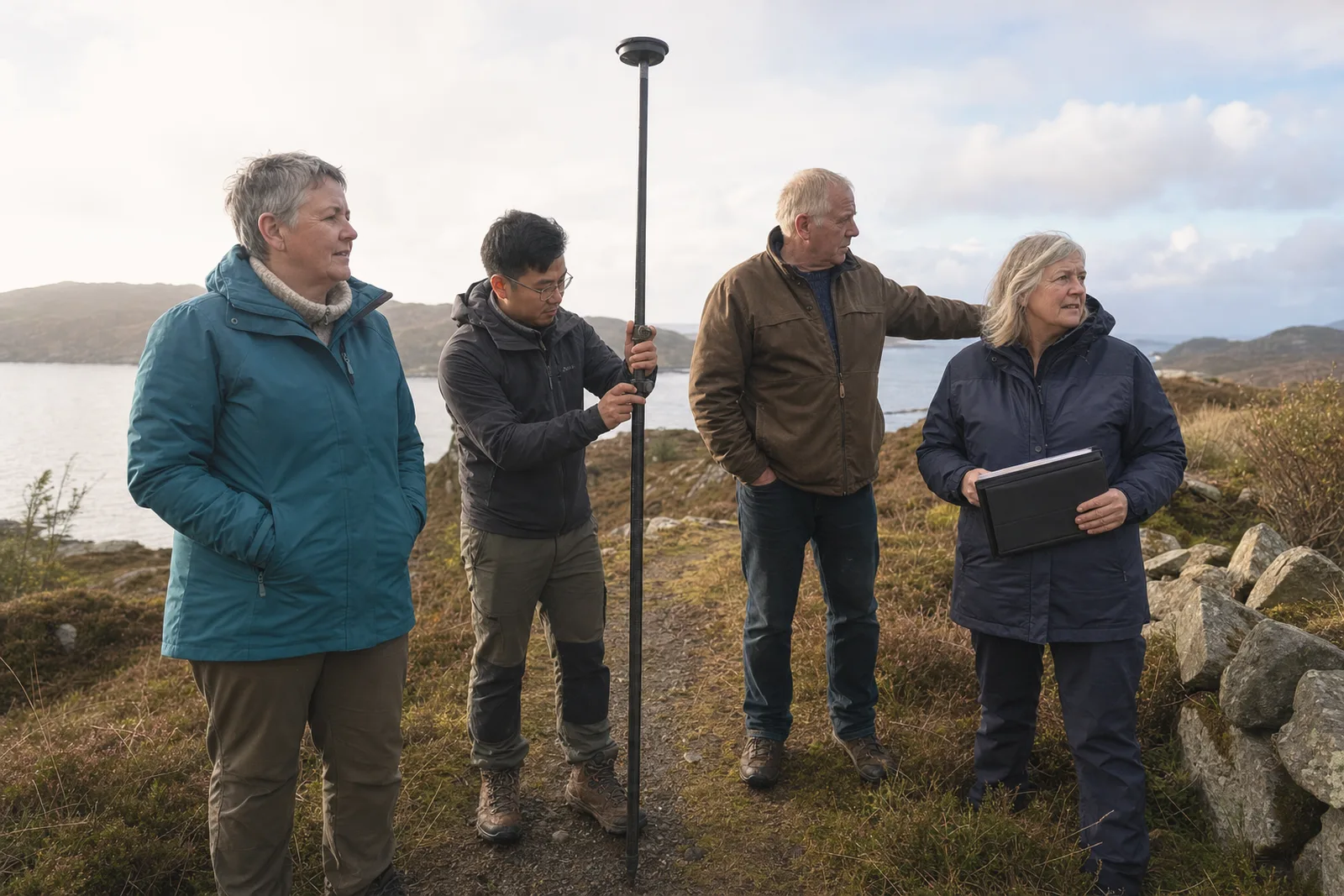
The land consolidation court is a specialist court that deals only with cases concerning real property. Proceedings often take place on site, with inspections, mediation and surveying. Here we go through a land consolidation case step by step: from submission of the demand to registration of the decision in the Land Register, what it costs, and how you appeal.
In brief
- The land consolidation court is a court for cases concerning real property, with land consolidation judges and engineers who survey and map.
- A case starts with a demand and an entry fee of five times the court fee, 6,725 kroner in 2026.
- The court sets the time for the first ordinary court hearing; an inspection may be part of the hearing.
- The case costs are apportioned according to the benefit the parties have from the case; you mainly bear your own lawyer’s costs yourself.
- Decisions can be appealed to the court of appeal within one month.
In brief: The land consolidation court is a separate court that deals with cases concerning boundaries, rights and property relationships in rural areas and in towns. It can both deliver judgments in disputes and carry out land consolidation, where property relationships are changed. What is special is that the case largely takes place on site: the court holds inspections, mediates, surveys boundaries and prepares maps. This guide belongs to the topic page on property law.
We explain what land consolidation is, and when you can demand a case, in What is land consolidation, and when can you demand a case?. This article is about how the case proceeds.
These are the rules
A separate court
The land consolidation courts are special courts of first instance, administered by the Norwegian Courts Administration. The country is divided into land consolidation districts under section 2-1 of the Land Consolidation Act (jordskiftelova), and you submit the demand to the land consolidation court where the property is located. The case is led by a land consolidation judge, and the court has its own engineers who are responsible for surveying, marking and maps. Under section 2-6, the court is also constituted with two lay land consolidation judges if a party demands it, or the judge considers it necessary.
The proceedings are governed by Chapter 6 of the Land Consolidation Act. Under section 6-1, a number of rules in the Dispute Act (tvisteloven) also apply, insofar as they are applicable. The land consolidation court is therefore a court with the same basic requirements for a fair trial as other courts.
Step by step
- 1. The demand: You submit a demand for a case in writing or orally (section 6-2). It must state who is demanding the case, which properties it concerns, and what you want decided. The courts have demand forms and guidance on domstol.no.
- 2. Check and fee: The court checks that the demand is formally in order, and may ask you to correct it within a deadline. An invoice for the entry fee is then sent. Once it has been paid, the demand is served on the other parties.
- 3. Case preparation: The parties submit documents, maps and the names of witnesses. Everything is shared with the other parties, who may comment. The court may call a preparatory hearing to clarify who the parties are, what the case concerns, and the progress of the case.
- 4. Court hearing and site inspection: The court sets the date for the first ordinary court hearing. The summons must be served at least two weeks before the hearing. A site inspection may form part of the court hearing. The number of court hearings varies depending on the case.
- 5. Mediation: The court must facilitate agreement (§ 6-17). If mediation succeeds, a judicial settlement is entered into.
- 6. The decision: Under § 6-23, the court decides disputes about factual and legal matters by judgment, procedural issues by ruling, and the land consolidation itself by a land consolidation decision.
- 7. Marking and registration: Boundaries are marked and assigned coordinates as far as possible (§ 6-29). The result is registered and reported to the municipal cadastre.
What does a land consolidation case cost?
The costs follow chapter 7 of the Land Consolidation Act. The fees are linked to the court fee, which is 1,345 kroner in 2026.
Under § 7-5, the court may adjust the total fees if the case takes substantially more or less time than usual. Under § 7-6, the legal costs are allocated between the parties according to the benefit they derive from the case. As a general rule, you bear your own costs for a lawyer and other expert assistance (§ 7-8). If the court gives judgment in a dispute, however, the rules on legal costs in the Dispute Act apply (§ 7-9). The losing party may then have to cover the other party’s legal costs.
This means that a boundary dispute that ends with a judgment can become far more expensive than the fees alone. If you have a low income, you can check whether you are entitled to free legal aid, or whether legal expenses insurance in your contents or home insurance covers the case.
Appeal
Decisions from the land consolidation court are appealed to the court of appeal (§ 8-1). The appeal deadline is one month (§ 8-3). Under § 8-2, as a general rule you may only appeal once the whole case has been decided, but a ruling may be appealed when it has been made, and the court may allow an earlier appeal. If an appeal has been lodged, implementation of the land consolidation may be postponed. Read more about appeals in general in the guide How to appeal a judgment.
Advice before you get involved in a case
- Obtain all older documents concerning the property early: deeds, registered agreements, old land reallocation records and maps from the National Archives.
- Notify the court of witnesses in good time, especially those who can give evidence about long-term use; see the guide on adverse possession.
- Read a settlement carefully before you agree to it. A judicial settlement is binding like a judgment.
- Ask the court early on what the case may cost, and how the costs may be allocated.
- If the case concerns access, see also right of way.
Are you involved in a property dispute and need someone to talk to? Become a supporting member – coming soon.
This is our members’ experience
The following are the members’ own experiences as they have told them to Justice for All Norway. They are not documented facts about every case, and we have not taken a position on the specific allegations in the cases.
Ole K. Vilnes from Askøy was a party in a land consolidation case in 2014. In the interview with us, he describes how the court hearing was organised.
We had a site inspection of the area on day 1, and then we had a hearing on day 2,
Vilnes chose to conduct the case without a lawyer. In his view, he presented strong evidence that maps used in the case had been manipulated, and he had five witnesses on how the family had used the area. He felt that the judgment did not address the witness statements.
Then the judgment comes, all my witnesses gone, not mentioned in a single word.
This is Vilnes’s own account, and we have not reviewed the judgment. Read more in the interview with Ole K. Vilnes.
Do you want help and a community with others who have been through similar cases? Become a supporting member – coming soon.
Frequently asked questions
How long does a land consolidation case take?
It varies a great deal. The court sets the date for the first ordinary court hearing, and the summons must be served at least two weeks before the hearing. The number of court hearings varies depending on the case. Large land consolidations involving many properties can take several years, while a simple boundary case that ends in a settlement may be completed much more quickly.
Do I need a lawyer in the land consolidation court?
No. You can conduct the case yourself, and the land consolidation court has a duty to guide the parties. If the case is a difficult dispute that may end with a judgment, it may nevertheless be wise to have a lawyer. Remember that, as a general rule, you bear your own legal costs, and that the loser in a judgment may have to cover the other party’s costs under the Dispute Act.
Who pays for a land consolidation case?
The person who brings the case pays the initial fee, and each party pays a party fee. The total legal costs are allocated according to the benefit the parties derive from the case, see the Land Consolidation Act § 7-6. In development-related land consolidation, the developer pays. Each party bears their own costs for lawyers and experts, except in disputes decided by judgment.
How do I appeal a land consolidation judgment?
Decisions from the land consolidation court are appealed to the court of appeal within one month, see the Land Consolidation Act §§ 8-1 and 8-3. The appeal is sent to the land consolidation court that decided the case. As a general rule, you may only appeal once the whole case has been decided, but a ruling may be appealed immediately. An appeal carries a fee under the Court Fees Act (rettsgebyrloven).
Sources
- Lovdata: the Land Consolidation Act
- Lovdata: the Land Consolidation Act chapter 7 – legal costs
- Lovdata: the Land Consolidation Act § 8-3 – appeal deadline
- Domstol.no: Submitted demand and case preparation
- Domstol.no: Court fees and costs
- Fact check: the legal references have been checked against Lovdata’s open data (current acts, retrieved 15 November 2026), and the other information against official online sources on 20 November 2026.
Quotes translated from Norwegian.
Published 20 November 2026 · Last updated 20 November 2026
About AI in our articlesSupporting members
Support Justice for All Norway from abroad
Membership of the association is open to people living in Norway. International supporting memberships are on their way, so that you can support our work wherever you live.
Become a supporting memberComing soon