News · Nobel Peace Prize
Navi Pillay receives the peace prize for having defined rape as a crime against humanity. At the same time, Norway permits the same crimes against its own children.
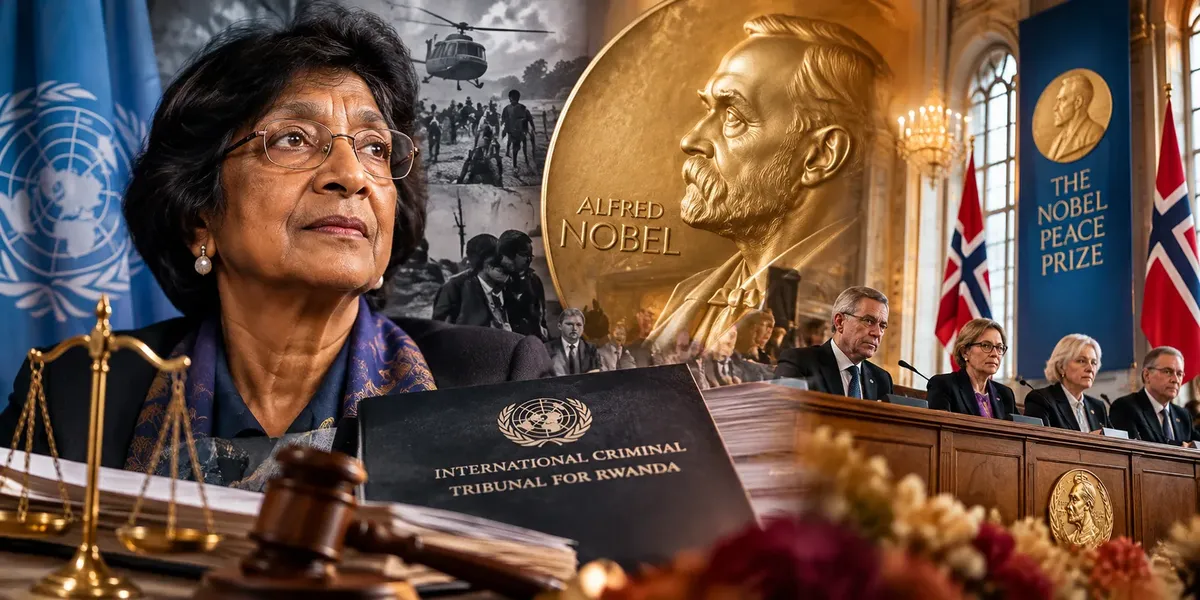
On 10 December the Norwegian Nobel Committee awards the Peace Prize to Navanethem “Navi” Pillay.
In its citation, the committee highlights that Pillay played a central role when the Rwanda Tribunal established that “rape and sexual violence constituted crimes against humanity”. It was a turning point in international law. Until then, rape had been treated as a side effect of war. Pillay’s own words on what the decision was to mean: rape is no longer to be a trophy of war.
Norway honours her for this. At the same time, the following is happening in Norway.
The association Justice for All Norway receives reports of a large number of cases in which children in the care of the Child Welfare Service (barnevernet) have been subjected to serious sexual abuse and violence. We hold documentation showing that children have been sent back to the place where the abuse took place — after the children themselves have described it. Not hinted at. Described. In facilitated interviews at the Children’s House (Barnehuset), which exists precisely for children who may have been victims of criminal acts, and to child welfare staff.
We hold documentation showing that the content of such interviews is deliberately withheld from the courts that were to decide where the children should live. The children say what has happened. The statement is recorded. And then it is left lying, while the court makes its decision without it. This has been confirmed by the lawyers in the cases concerned.
These are not isolated cases. The European Court of Human Rights has decided 31 Norwegian child welfare cases. Norway has been found in breach in 25 of them. That figure does not come from a website or an activist. It comes from the Norwegian National Human Rights Institution, the state’s own body.
And it is happening in a legal system that cannot be reviewed. The Storting (the Norwegian Parliament) adopted a requirement for audio and video recording in Norwegian courts when the Dispute Act was considered in 2005. Twenty-one years later it has not been implemented. There are no recordings, no stenographer, no documentation of what was actually said in the courtroom that can be held up against the judgment. When a parent or a child says that the statement was not reproduced correctly, and that very serious evidence was kept from the court by child welfare heads in several municipalities and cases, there is nothing to compare it with. The system is set up so that it cannot be disproved.
So let us ask the question the committee’s own citation invites.
If rape and sexual violence against adults can constitute crimes against humanity — what then is sexual violence against children, committed while the child is in the custody of the state, and repeated because the state sent the child back to the abuser?
International law has a criterion here, and it is worth taking seriously precisely because it is strict: a crime against humanity presupposes a widespread or systematic act directed against a civilian population. It is not a term to be bandied about. But 25 judgments against Norway in Strasbourg, a practice in which children’s own statements do not reach the courts, and a justice system without verifiability — that is not a collection of accidents. It is a pattern. And the pattern is the legal criterion.
Norway has built its international reputation on being a peace broker in the Middle East and the country that awards the Peace Prize. That position gives Norway a voice in rooms the country would otherwise not be let into. And it rests on one premise: that the country awarding the prize itself lives up to what the prize honours.
That premise no longer holds. A country that has been found in breach 25 times for its treatment of children and parents, that has not implemented the Storting’s own decision on verifiable court proceedings in twenty-one years, and where children in the state’s care who speak about abuse are sent back to the abuser — that country does not have the moral authority the award presupposes.
We therefore propose that Norway be stripped of the right to award the Nobel Peace Prize, until these matters have been examined by an independent body, and Norway is held accountable for its crimes against humanity.
It is a drastic proposal. It is meant to be. The alternative is that Norway continues to stand on the stage of Oslo City Hall on 10 December and honour a woman who devoted her life to ensuring that abuse of the defenceless has consequences — while Norwegian children are sent back to their abusers by the same country’s public administration and courts.
Navi Pillay deserves the prize.
It is the country awarding it that is not worthy of the role of awarding the prize.
Quotes translated from Norwegian.
Related articles
Three in four are refused when they apply for patient injury compensation

Limit values assess one substance at a time. The body meets many

Amicable settlement with VG: – We should simply have called you
We published the entire closing speech. The court makes no such recording itself
Children who speak out have the right to be taken seriously