News · Rules and advice
The tribunal hearing: who sits there, and how does it work?
The major child welfare cases, such as care orders and adoption, are decided at a hearing before the Child Welfare Tribunal. The hearing resembles a trial, with parties, lawyers, witnesses and a panel of three. Here is who sits there, what happens, and how you can prepare.
In brief
- An ordinary tribunal consists of the chair, one lay member and one expert member. In particularly difficult cases it can be enlarged to five (section 14-3 of the Child Welfare Act).
- Proceedings must be fair, sound, swift, efficient and confidence-inspiring, and the parties must normally present evidence through oral testimony (section 14-5).
- The hearing is held in private, but the tribunal may open it in whole or in part if the private parties ask for this (section 14-17).
- The tribunal may only rely on expert reports that have been assessed by the Commission for Child Welfare Experts, except in emergency cases (section 14-18).
- The case may be heard even if a private party does not attend, provided that party was properly summoned (section 14-15).
Short answer: At a hearing, the tribunal normally consists of three people: a chair who is a lawyer, a lay member and an expert member. The parties, that is the parents and the municipality, present their case through their own lawyers, call witnesses and respond to each other’s arguments. The decision must be based on what emerges at the hearing. This article belongs to the topic page on child welfare.
These are the rules
The composition of the tribunal is set out in section 14-3 of the Child Welfare Act (barnevernsloven). An ordinary tribunal consists of the chair, one member from the general panel and one from the panel of experts. The chair may decide that particularly difficult cases are to be heard by an enlarged tribunal with two members from each panel. The chair may also decide a case alone, but only if this is sound and the parties consent, or in certain types of case, such as a claim to change an earlier decision, where it is unobjectionable.
The main principles of procedure are set out in section 14-5. Proceedings must be fair, sound, swift, efficient and confidence-inspiring. The tribunal must ensure that the parties can argue their case and present evidence, normally through oral testimony given directly to the tribunal, that they can respond to the other side’s arguments and evidence, and that they are treated equally and given the guidance they need. The tribunal must also make an independent and genuine assessment of the evidence, and the decision must state reasons. How the tribunal is organised is explained in the Child Welfare Tribunal.
Who sits at the hearing?
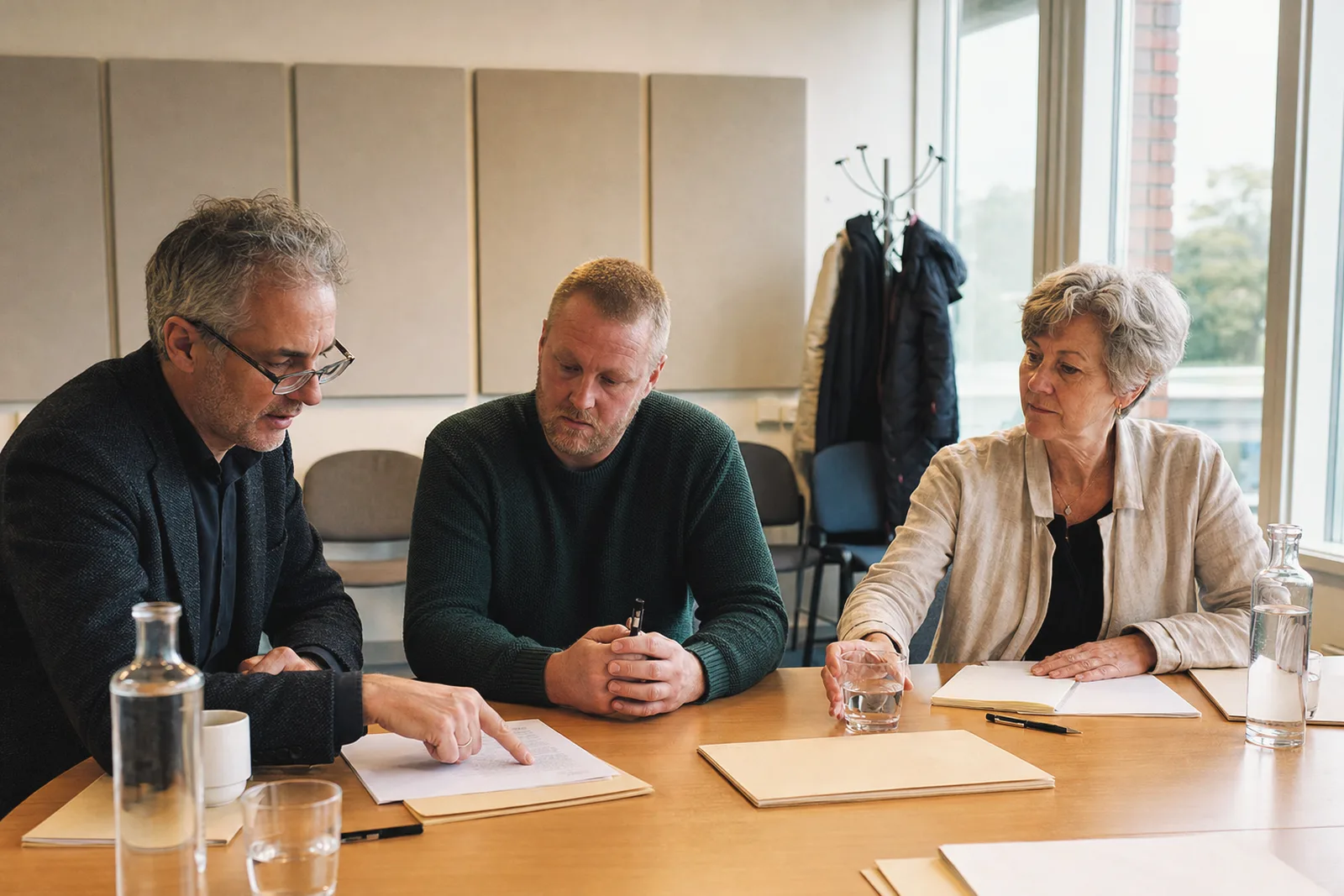
The tribunal sits at the table, often on one side. The chair conducts the hearing and makes sure it stays within its limits. The expert member comes from the panel of experts and can ask questions that go straight to the professional issues. The lay member is there to contribute ordinary life experience. On the other side sit the municipality, represented by a lawyer and usually a caseworker from the child welfare service, and the parents with their lawyer. The child may have a spokesperson or, in some cases, a lawyer of their own.
Under section 14-17, the hearing is held in private. If the private parties ask, the tribunal may open it in whole or in part, where this is unobjectionable having regard to the child and the case. With the parties’ consent, the tribunal may also allow people connected with one of the parties to attend, for example a support person. They are then bound by confidentiality.
How does the hearing work?
Under section 14-15, the parties must be summoned. If you have a lawyer, the summons goes through your lawyer. The case may be heard even if you do not attend, as long as you were properly summoned. It is therefore important to attend, or to let the tribunal know in good time if you cannot. In the Jallow case from 2021, the ECHR considered a case in which a father was not granted a visa and could not be physically present, and found no violation of Article 6; see Jallow v. Norway.
At a typical hearing, the municipality’s lawyer opens and explains why the municipality considers the conditions to be met. The parents’ lawyer then opens. The parties then give evidence, and the witnesses are heard in turn, with questions from both lawyers and from the tribunal. Finally, the lawyers make their closing submissions. Under section 14-16, the chair conducts the hearing, and section 9-15 of the Dispute Act on the court’s conduct of the main hearing applies correspondingly as far as appropriate. The section also allows the chair to decide the case on the papers if this is sound and the parties consent.
Under section 14-19, the decision must be made on the basis of what was dealt with at the hearing. That is an important rule. What is not presented and discussed at the hearing should, as a starting point, carry no weight. If you have something to say, the hearing is the place to say it.
The child, the witnesses and the documents
Under section 14-13, the tribunal must decide specifically how the child is to be heard. The child may speak directly to the tribunal, or the tribunal may appoint a spokesperson or an expert to talk to the child. See spokespersons in child welfare cases and the child’s right to participate.
For evidence, under section 14-18, the rules of the Dispute Act on evidence, witnesses and experts apply as far as appropriate. The tribunal may only rely on expert reports that have been assessed by the Commission for Child Welfare Experts, except in emergency cases; see the Commission for Child Welfare Experts. You can call witnesses yourself. They might be people who know the family well, such as a teacher, a health visitor, a therapist or a neighbour.
How you can prepare
Go through all the documents in the case with your lawyer, and work out which claims you disagree with. Ask for access to anything you have not received; see a party’s right of access. Make a list of witnesses who can shed light on what the municipality has missed, and talk to your lawyer about what each of them will say. Prepare your own evidence: what is everyday life like, what has changed, and what do you think about the child’s needs? It is fine to show feelings, but it is easier for the tribunal to use what you say when you are specific. Legal representation is essential; see child welfare lawyer.
This is our members’ experience
Many parents who have been through a hearing describe it as one of the hardest experiences of their lives. At the same time, experience shows that a well-prepared opponent can change the entire hearing. In the filmed interview with Justice for All Norway, lawyer Barbro Paulsen described a case in which she and the child’s lawyer presented an expert assessment that the municipality was unable to answer, during the days the case was before the court:
They could not give a sensible answer to anything we said.
Experience shows that it helps to remember that the tribunal consists of people who must assess the evidence independently. The parent who has prepared well, and who has witnesses who can speak specifically, gives the tribunal a better basis than the one who merely disputes what the municipality says.
If you would like to support our work, you can become a member here.
Frequently asked questions
Who sits on the tribunal at a hearing?
Under section 14-3 of the Child Welfare Act, an ordinary tribunal consists of the chair, one member from the general panel and one from the panel of experts. In particularly difficult cases, the chair may decide that the tribunal is to be enlarged with one member from each panel.
Can the case be heard if I do not attend?
Yes. Under section 14-15 of the Child Welfare Act, the case may be heard even if a private party fails to attend, as long as that party was summoned in accordance with the rules. So let the tribunal know in good time if you cannot attend.
Is the hearing before the Child Welfare Tribunal public?
No, hearings are held in private under section 14-17 of the Child Welfare Act. The tribunal may nevertheless open the hearing in whole or in part if the private parties ask for this and it is unobjectionable having regard to the child and the case.
Can the tribunal decide the case without a hearing?
Yes, in some cases. Under section 14-16 of the Child Welfare Act, the chair may decide the case on the papers if this is sound and the parties consent, or in certain types of case, such as a claim to change an earlier decision, where it is unobjectionable.
Sources
Quotes translated from Norwegian.
Published 22 November 2026 · Last updated 22 November 2026
About AI in our articlesSupporting members
Support Justice for All Norway from abroad
Membership of the association is open to people living in Norway. International supporting memberships are on their way, so that you can support our work wherever you live.
Become a supporting memberComing soon