News · Rules and advice
Child welfare, minorities and families from other cultural backgrounds
When the child welfare service meets families from other cultural backgrounds, language, culture, ethnicity and religion must be taken seriously at every stage of the case. Parents should ask for written clarification, and the family and network should be brought forward early.

In brief
- The child welfare service must take account of the child’s ethnic, cultural, linguistic and religious background at every stage of the case (section 1-8 of the Child Welfare Act).
- The Act applies to children habitually resident and present in Norway, regardless of nationality (section 1-2).
- The child welfare service must cooperate with children and parents as far as possible and make arrangements for the family and network to be involved (section 1-9).
- The child welfare service must consider the family and close network as a foster home (section 9-4).
- If you cannot communicate adequately in Norwegian, the child welfare service must use an interpreter (section 6 of the Interpreting Act).
Short answer: The Child Welfare Act applies to all children living in Norway, including children of parents from other backgrounds. At the same time, the Act requires the child welfare service to take account of the child’s ethnic, cultural, linguistic and religious background throughout the case. Culture is no excuse for exposing children to harm, but it must form part of the assessment. This article belongs to the topic page on child welfare.
These are the rules
The central rule is in section 1-8 of the Child Welfare Act (barnevernsloven). In its work, the child welfare service must take account of the child’s ethnic, cultural, linguistic and religious background at every stage of the case. The particular rights of Sami children must be safeguarded. The duty applies from the first report of concern, through the investigation and any support measures, to the choice of foster home and contact after a care order. The consideration concerns the child’s background, not only the parents’, and it must be assessed specifically for each child in the family.
Who the Act applies to is set out in section 1-2. It applies to children under 18 who are habitually resident in Norway and present here, and to children who are refugees or internationally displaced. For children habitually resident in another state but present in Norway, certain decisions may be made, including on support measures and emergency measures. The Act applies subject to the limitations that follow from international law.
When language and concepts create distance
Many misunderstandings in child welfare cases are not about language alone, but about concepts. Words such as attachment, setting boundaries, parenting capacity and cooperation may be unfamiliar or mean something else in the family’s own language and culture. Ask the child welfare service to explain what they mean by the words they use, and what specifically they are concerned about. If you cannot communicate adequately in Norwegian, the child welfare service must use an interpreter under the Interpreting Act, and your child must not interpret. See interpreters in child welfare cases.
How to prepare for meetings
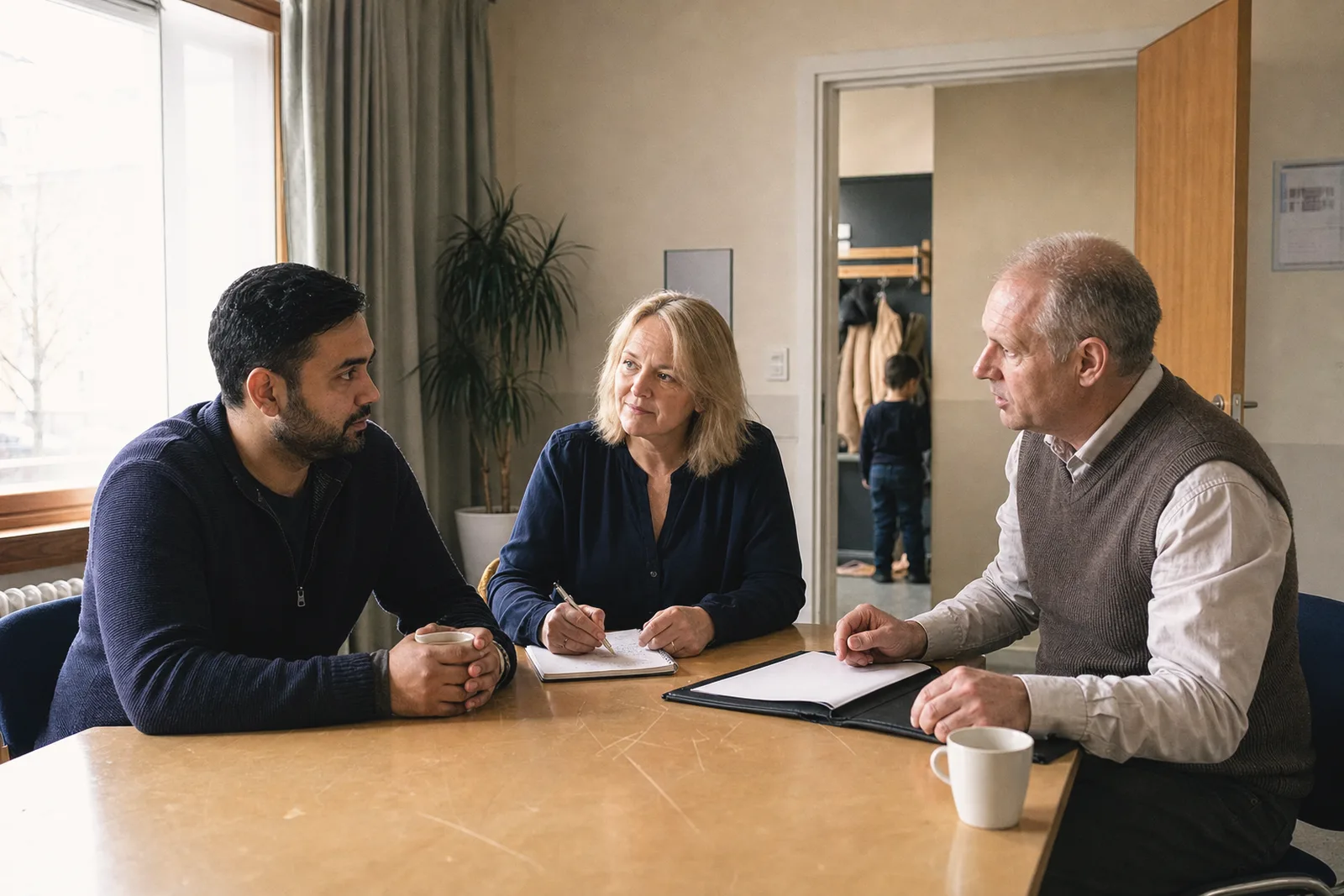
Ask in advance what the meeting will be about and who will be there. Bring someone you trust, preferably someone who knows both your culture and the Norwegian system. Write down your questions before the meeting, and write down afterwards what was said and agreed. Ask for written minutes. If you disagree with anything in them, say so in writing. Advice on recording meetings is in can I record a meeting with the child welfare service, and how the investigation works in investigation by the child welfare service.
Feel free to tell the child welfare service about the family’s traditions, faith and upbringing, and about what matters to you. Under section 1-9, the child welfare service must cooperate with the parents as far as possible, treat them with respect and make arrangements for the family and network to be involved. It is easier for the child welfare service to take account of the child’s background when it knows what that background is. You have a right to read what is written about the family; see a party’s right of access.
Family, network and culture in placements
If the child has to move, the child welfare service must under section 9-4 consider whether someone in the family or close network can become a foster home. For many minority families the network is large and may include relatives in several countries. Tell the child welfare service early who might be suitable. See foster care within the family and network.
The ECHR has said something important about this. In the Grand Chamber judgment Abdi Ibrahim v. Norway from 2021, the Court read the right to family life in the light of freedom of religion. The state has a duty to try to find a foster home that matches the child’s background, but not a duty to succeed. Where no such home is found, the requirement that the child be able to keep ties to the family’s culture and faith through contact becomes stronger. Read more in religion and culture in child welfare cases.
When the family has ties to several countries
If the family has citizenship or relatives in another country, the case may acquire an international dimension. The Child Welfare Act nevertheless applies when the child is habitually resident in Norway. Parents living abroad have the same rights as parties as other parents, and taking part by video may be possible. What the ECHR has said about foreign families, relatives in other countries and parents living outside Norway is in foreign families and the child welfare service.
Check the decision
When the decision comes, look at whether it says anything about the child’s background. Under section 12-5, the decision must show the facts and assessments on which it is based, and how the child’s best interests and the consideration of family ties have been assessed. If it says nothing about language, culture or religion although these mattered in the case, that is an argument in an appeal or in a case before the district court.
If the concern relates to forced marriage, strict control or threats from the family itself, the police and other support services can also help. See negative social control and honour-based violence.
This is our members’ experience
Several families from other backgrounds who contact Justice for All Norway describe meetings where they did not understand what the child welfare service was concerned about, and decisions that do not mention the family’s language, faith or network. Some found that relatives who came forward were never assessed. Experience shows that the family is in a stronger position when it asks for an interpreter from the outset, explains its background in writing and tells the child welfare service about the network early.
If you would like to support our work, you can become a member here.
Frequently asked questions
What does the Child Welfare Act say about the child’s culture and language?
Under section 1-8 of the Child Welfare Act, the child welfare service must take account of the child’s ethnic, cultural, linguistic and religious background at every stage of the case. The particular rights of Sami children must be safeguarded.
Does the Child Welfare Act apply to foreign children in Norway?
Yes. The Act applies to children habitually resident and present in Norway, regardless of nationality, and to children who are refugees. For children habitually resident in another state, certain decisions may be made, including on support measures and emergency measures (section 1-2).
Must the child welfare service cooperate with parents from minority backgrounds?
Yes. Under section 1-9, the child welfare service must as far as possible cooperate with children and parents, treat them with respect and make arrangements for the family and network to be involved. This applies to all families.
Must the child welfare service consider family or network as a foster home?
Yes. Under section 9-4, the child welfare service must consider whether someone in the child’s family or close network can become a foster home. The family is nevertheless not entitled to be chosen.
Sources
Published 22 November 2026 · Last updated 22 November 2026
About AI in our articlesSupporting members
Support Justice for All Norway from abroad
Membership of the association is open to people living in Norway. International supporting memberships are on their way, so that you can support our work wherever you live.
Become a supporting memberComing soonRelated articles
Interpreters in child welfare cases: the right to understand and be understood
A child welfare investigation: what are they allowed to do, and what can you demand?

Can you record conversations and meetings with the child welfare service?

Foster care with relatives and the wider network: does the family have priority?

Religion and culture in child welfare cases: what the Abdi Ibrahim judgment requires
Foreign families and the child welfare service: what the ECHR judgments mean